
Inquiries have been increasing again recently, perhaps because of social media, so for the first time in a while we present a case with MiniWELL Ready / MiniWELL PROXA.
The patient first visited us in September 2024, traveling from his workplace in Okayama Prefecture, for consultation about cataract surgery with multifocal intraocular lenses. He had cataracts consisting mainly of cortical opacity, worse in the right eye, and corrected visual acuity had fallen to 0.5–0.6. The left eye maintained corrected visual acuity of 1.2, but its contrast sensitivity appeared considerably reduced by the same type of cataract, and he booked surgery on both eyes. A simple corneal topography test at the first visit suggested that multifocal lenses could be used, but we told him that more detailed tests were needed for a final judgment of candidacy.
In the preoperative questionnaire collected at the second visit, he had written in bold in the margin, "I don't want to wear glasses," and his priority was near > intermediate > far. More detailed corneal topography over a wider area also showed low irregular astigmatism, so we first considered a trifocal lens that reliably secures near and intermediate vision as the first choice. However, he plays golf and sometimes drives at night, and he himself wished for surgery with the "WELL Fusion system" (Japanese), a mix-and-match of MiniWELL Ready and MiniWELL PROXA.
Recognized for our track record with the MiniWELL, our clinic, as an early-adopter facility, performed the first WELL Fusion in Japan five years ago. With WELL Fusion it is generally recommended to use MiniWELL in the dominant eye and PROXA in the non-dominant eye, and to operate on the dominant eye first.
In ordinary cataract surgery, on the other hand, unless there is a special reason, we operate first on the eye whose cataract has progressed and whose vision has fallen. In this case, the dominant eye was the left eye, with relatively less advanced cataract, so we gave priority to the WELL Fusion approach and changed the order to operate first on the left (dominant) eye with the MiniWELL.
Next, ordering the lenses (= deciding the power): these lenses are imported from overseas and must be ordered about one month before surgery. Both eyes were long eyes (highly myopic) with axial lengths exceeding 26.5 mm, and the corneas were somewhat flat, so considering the possibility of power deviation (postoperative refractive error), we prepared two powers of MiniWELL for the left eye and two powers of PROXA for the right eye.
First, surgery on the dominant left eye. The lens was slightly swollen, requiring care during the anterior capsulotomy, but the cataract was not hard, with nuclear grade around 1.5, so lens removal went smoothly.
Next came intraoperative wavefront aberrometry with the ORA system. The MiniWELL is not optimized within the ORA system, so ORA's recommended value cannot simply be adopted. At our clinic, we therefore created a regression formula from the difference between values for the dummy lens used for standardization and actual measurements, and use that correction to decide the power, so as to bring refractive error close to zero.
This time, as shown below, rather than the +12.0 D lens recommended by ORA, we chose the +12.5 D lens targeting −0.64 D, also inserted a capsular tension ring (CTR) for long-term lens stability, and completed the surgery without problems. We had prepared +12.0 D and +12.5 D lenses, so in the end we used the one leaning toward near.

On the day after left eye surgery, the refractive error we had feared did not occur, and he had good distance and near vision of 1.2p distance / 1.2 near. At one week, he had 1.2–1.5 distance / 1.0 near (30 cm), near vision better than the usual MiniWELL specifications, and he was very satisfied. Since near vision was already well secured at this point, we told him that the standard MiniWELL rather than PROXA might suffice for the non-dominant eye, but he chose PROXA as originally planned.
Next came surgery on the non-dominant right eye, with the more advanced cataract. Since the cataract had advanced in one eye only, we operated carefully, considering factors such as trauma, and again decided the lens power with reference to ORA measurements.
Since we first used PROXA in Japan five years ago, our clinic has been saying that "the constant for deciding power (A-constant) is very likely not the same as for the standard MiniWELL, and calculating power with the manufacturer's recommended A-constant may lead to refractive error." As we have accumulated cases and optimized, this has become clear not only as an impression but in numbers. The manufacturer's recommended value has also since changed, but power selection still requires adjustments different from those for the standard MiniWELL.
With this in mind, we chose the appropriate power from the two lenses prepared, again used a CTR, and completed the surgery without problems.
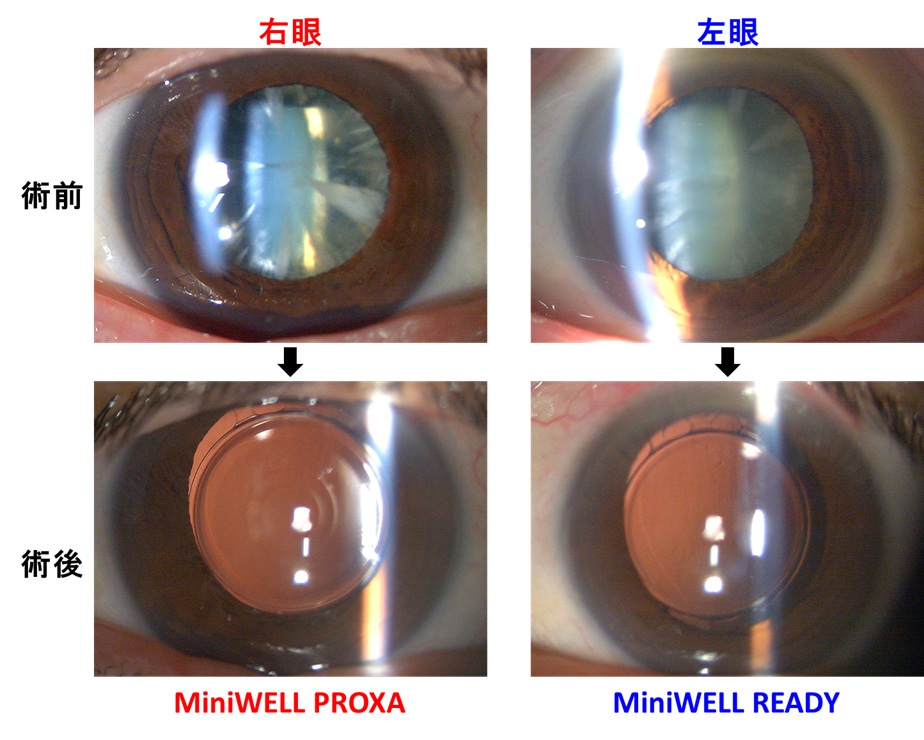 On the day after surgery, uncorrected vision in the right eye was somewhat poor at 0.8p distance / 0.6 near, but by day 3 it had improved to 1.2 distance / 1.2 near. On day 10 it was 0.8p distance / 1.5 near; he himself was not much bothered, but distance vision was somewhat unstable.
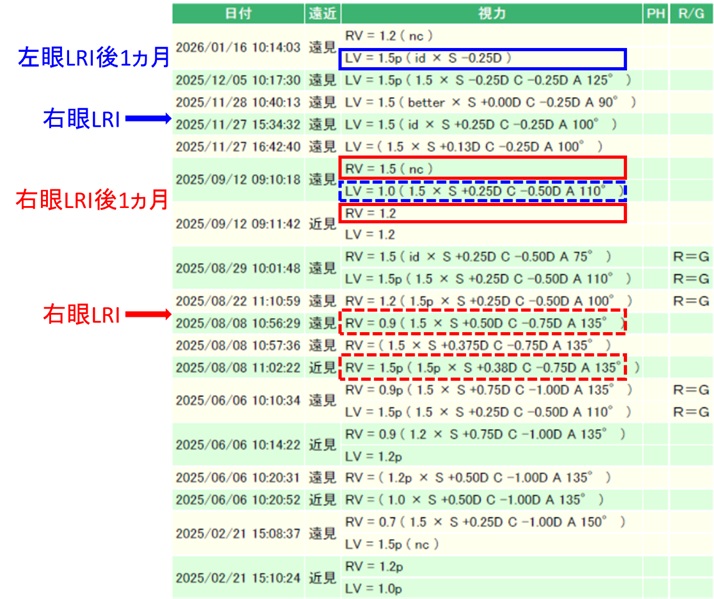
After that, distance vision stayed between 0.7 and 0.9 (dotted red frame in the visual acuity table below), but during follow-up we found that simply correcting mild residual astigmatism (0.75 D) would very likely improve distance vision to 1.5. Astigmatism correction is not covered by insurance, but I am the type who wants to improve whatever can be improved, so I presented it as an option for improving uncorrected vision, and he chose astigmatism correction by limbal relaxing incisions (LRI).
Astigmatism of about 0.75 D rarely reduces vision with the standard MiniWELL, but this case also suggested that PROXA may be more affected by astigmatism than MiniWELL. (A toric PROXA was not available at the time, but it is now (Japanese).)
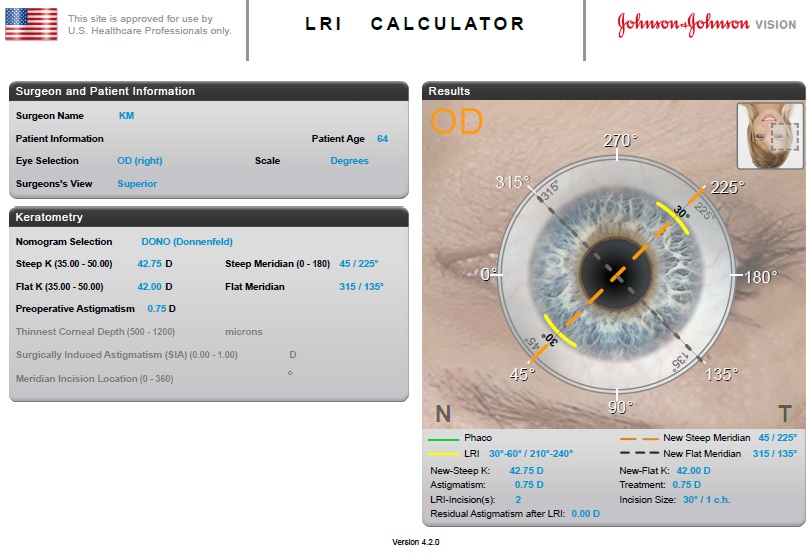
As shown above, a 30-degree incision centered on the steep meridian should, by calculation, correct 0.75 D of oblique astigmatism, but in real practice things rarely go exactly as calculated. Here too, referring to real-time values from the ORA system, we performed ORA system-guided LRI, repeating the steps of adding incisions and measuring, so as to bring astigmatism as close to zero as possible without overcorrection.
As a result, from the day after LRI uncorrected distance vision improved to 1.2, and by one month astigmatism was zero. Nine months had passed since the first cataract surgery, but he finally achieved good vision of 1.5 distance / 1.2 near and was very satisfied (red frame in the visual acuity table below).
As a postscript, partly because the right eye did so well, he asked to have the astigmatism in his left eye corrected as well, though it was only about 0.5 D. We told him there was little need for it in the left eye, but at his strong request we finally performed ORA-guided LRI. As a result, astigmatism in the left eye also became zero, and he felt a subjective improvement too.
The MiniWELL gives vision close to that of the natural lens, making it suitable for cases such as single-eye cataracts in younger people. When candidacy is judged properly, postoperative dissatisfaction is extremely rare, and it is a high-performance progressive multifocal lens that is also easy for surgeons to work with.
On the other hand, as we have mentioned before, its optical characteristics make it susceptible to even slight posterior capsule opacification (secondary cataract), so laser posterior capsulotomy (treatment of posterior capsule opacification) is almost always necessary. This tendency does not change even if the lens epithelial cells that cause it are removed by scraping during surgery. It is strange that this visual impairment from posterior capsule opacification, which seems specific to the MiniWELL, has not been announced anywhere, including by the manufacturer, academic societies or other medical institutions, but our clinic explains it before surgery just in case. That said, a safe treatment is established, so I do not think it needs to be weighted heavily as a factor deciding whether to choose the lens. This patient is now more than a year after surgery and, at present, has no visual impairment from the posterior capsule opacification seemingly specific to the MiniWELL, maintaining good vision.
Next, MiniWELL PROXA: if refractive error is minimized and the target refraction is hit accurately, it is one of the multifocal lenses that lets you see closest without sacrificing distance vision. However, its power selection and use have unique characteristics and demand greater accuracy, so it is harder to handle than the MiniWELL; under some conditions, though, it can be set to give better distance and near vision than the MiniWELL. On the other hand, photic phenomena such as halos at night tend to occur more than with the standard MiniWELL, so I consider it a lens suited to people who want to see clearly down to 30 cm or who are not satisfied with the MiniWELL.
This is our first MiniWELL case published in three years, but during that time our clinic has continued to use both MiniWELL and PROXA. Compared with eight years ago, when we began using the MiniWELL, far more medical institutions now handle it, and with the spread of social media, in addition to inquiries from patients, we are increasingly consulted by other clinics about target refraction. We are very glad that the environment for patients to access better care is expanding.
On the other hand, however high-performance the lens, our clinic consistently does not recommend surgery when there is almost no visual impairment from cataract, so-called Refractive Lens Exchange (RLE). Of course, for people with high myopia, or after accommodation has declined or been lost with presbyopia, the benefits may be large. But among the people who come to us with problems after surgery, in quite a few cases one factor was insufficient understanding of the disadvantages (things that get worse) of surgery, so please keep this in mind.
This is a self-pay lens, so there is no problem in choosing it if you are fully convinced. But if problems arise after surgery and the institution where you had surgery cannot handle them adequately, and you see another clinic, treatment there will also be self-pay. We recommend choosing a lens after understanding not only the benefits but also points like these.
Finally, an announcement. Owing to recent price increases and exchange rates, we very much regret that from 2026 the fee for MiniWELL Ready / MiniWELL PROXA has been revised to 770,000 yen (including tax) per eye, and 825,000 yen (including tax) per eye for each toric version. The fee includes preoperative tests, surgery with the ORA system, lens costs (two lenses in total, including one backup lens of a different power), a capsular tension ring (CTR), and examinations, tests and medications up to 3 months after surgery. As before, our clinic bears the cost of importing and returning the backup lens of a different power. Thank you for your understanding.
2026.02.18