
As we mentioned previously, this is a case in which poor uncorrected vision due to residual astigmatism after surgery was corrected without exchanging the lens.
The patient had already seen several eye clinics, and first visited us without a referral letter in February 2025 for consultation about cataract surgery. Not only on examination but also functionally, the cataract was already reducing his vision, so he could have surgery at any time. He himself wanted Clareon Vivity, an extended depth of focus multifocal lens, so after confirming that his eyes could make proper use of multifocal function, we asked him to return if he wished to have surgery at our clinic. Many first-time patients want to book a surgery date on the spot in the heat of the moment, so to give them time to think carefully, at the first visit we limit ourselves to explaining the current state of the cataract and any other conditions, and whether surgery would restore vision. If they wish to have surgery, we ask them to return, and based on the preoperative questionnaire they proceed to tests for choosing a suitable lens type and setting the target power.
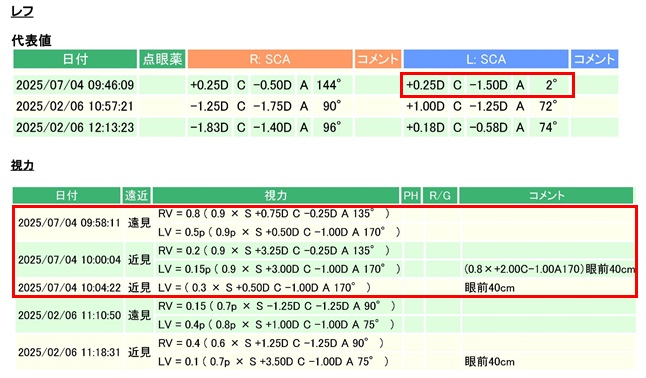
He did not book surgery at our clinic after that, but in early July, one month after surgery elsewhere, he returned, saying, "I had cataract surgery with Vivity at another clinic in early June, but my left eye is hard to see with, so I'd like to consult about exchanging it for a toric lens." He had neither a referral letter nor a lens card, so the details of the lens used were unknown, but no toric lens had been used, and refraction testing of the left eye, shown below, detected 1.50 D of with-the-rule astigmatism (red frame on the autorefraction in the figure below). Uncorrected vision was poor at 0.5p distance / 0.15p near. Correcting only the astigmatism, as he wished, could be expected to improve distance to about 0.9p, but near vision only to about 0.3, so my impression was that, besides the effect of residual astigmatism, he was not making good use of Vivity's near add (red frame on visual acuity in the figure below).
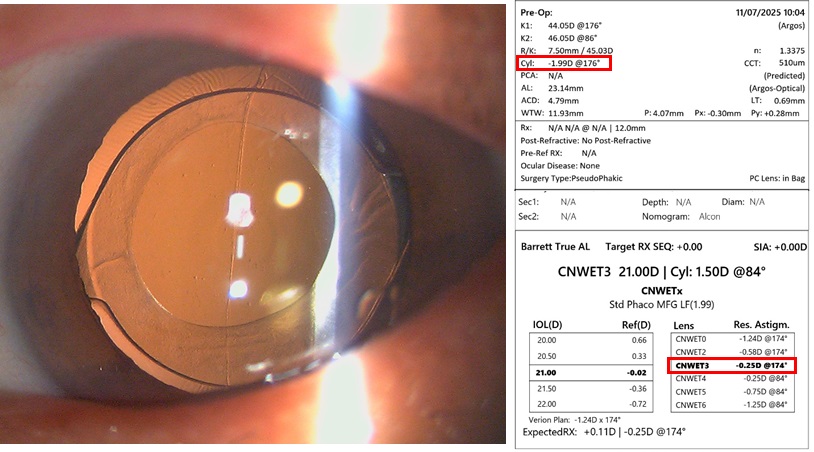
As for the lens, as shown on the left of the figure below, no toric axis marks could be seen, so it did not seem to be a toric lens. The anterior capsulotomy margin was on the small side and may have been contracting, but since it was only one month after surgery, we told him that, in our experience, lens exchange could usually be performed without difficulty. Depending on the measuring instrument, anterior corneal astigmatism at the visit was 1.99 D with-the-rule (red frame at the top of the figure below), and we told him that, to avoid overcorrection, the cylinder power for an exchange would be T3 = 1.5 D or T2 = 1.0 D (red frame at the bottom of the figure below). We also stressed that even after exchanging for a toric lens, as noted above, vision might improve only to about 0.9, his corrected vision with glasses that day, and explained that if the only aim was astigmatism correction, there were options other than exchange: an add-on lens or limbal relaxing incisions (LRI).
Because the surgery had been done elsewhere, an exchange at our clinic would be self-pay rather than covered by insurance, so we told him that, whether exchange, add-on or LRI, continuing treatment at the clinic that performed the surgery might be more advantageous, including in cost. How the decision for surgery was made at the previous clinic is unclear, but he said he had undergone same-day bilateral surgery at a Tokyo clinic near his home, as the doctor told him. Given this, and that the clinic advertised that it also performs redo cataract surgery, after discussion with him we judged that, ethically too, it was appropriate for him first to continue treatment with the doctor he had chosen. We do not know what was discussed after that, but he said he was advised to wait and see, with no proposal of exchange or LRI, and a week later he returned wanting to have surgery at our clinic after all.
As the visual acuity table above shows, at one month after surgery the right eye's subjective refraction had a slight hyperopic shift, but the left eye's refraction was spot on, and, literally, astigmatism alone seemed to be causing the reduced uncorrected vision. In other words, to improve uncorrected vision at this point, the right eye would need a change in lens power (= exchange), but the left eye did not need its power changed. He was also very worried about the risks of exchange surgery, and cost was a concern too, so we again suggested that limbal relaxing incisions (LRI) might suffice instead of exchange. Another advantage is that, unlike exchange, the risks of LRI do not increase as time passes after cataract surgery, so he could take his time to consider.
As we have mentioned several times in our case collection (Japanese), LRI is a method of correcting mild corneal astigmatism, up to about 1.5 D, with incisions. It cannot fully correct strong astigmatism of 2.0 D or more, but it is very minimally invasive and a simple procedure taking a few minutes. It also costs far less than exchange; at our clinic, LRI alone combined with ORA is performed as self-pay treatment for 55,000 yen (including examinations and medication up to 1 month after surgery).
Specifically, as shown below, a 40-degree arcuate incision is made in the periphery of the cornea along the steep astigmatic axis (steep meridian), reducing tension in that direction and flattening it, correcting 1.25 D of corneal astigmatism. Although it is called an incision, it goes only about 90% of the corneal thickness and creates no communication between the outside and inside of the eye, so it is a very low-risk procedure. Normally the amount of incision is predicted from a nomogram based on cylinder power, age, axis orientation and so on, so precision was not great; at our clinic, however, by combining the ORA system and correcting while measuring changes in astigmatism in real time during surgery, we have become able to correct precisely up to the limit (ORA system-guided LRI). In terms of accuracy, though, femtosecond laser AK combined with ORA seems best, so please look it up if you are interested.
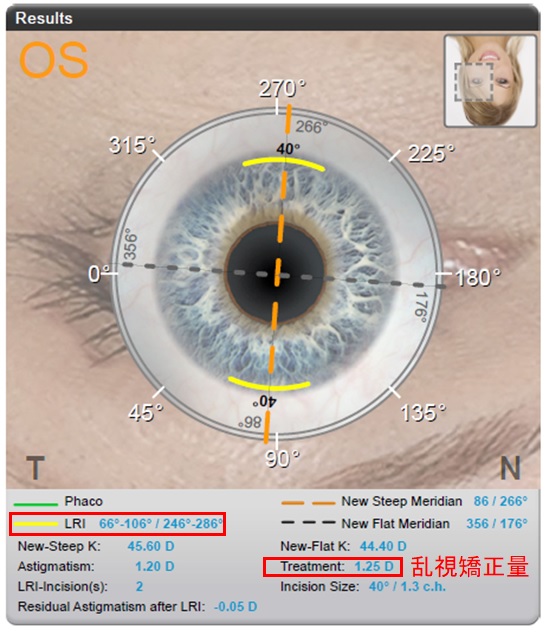
We added that toric lenses are usually made in 0.5–0.75 D steps, so LASIK or LRI can sometimes leave less residual astigmatism, and that if he was not satisfied, the lens could still be exchanged after LRI. In the end he chose LRI rather than exchange.
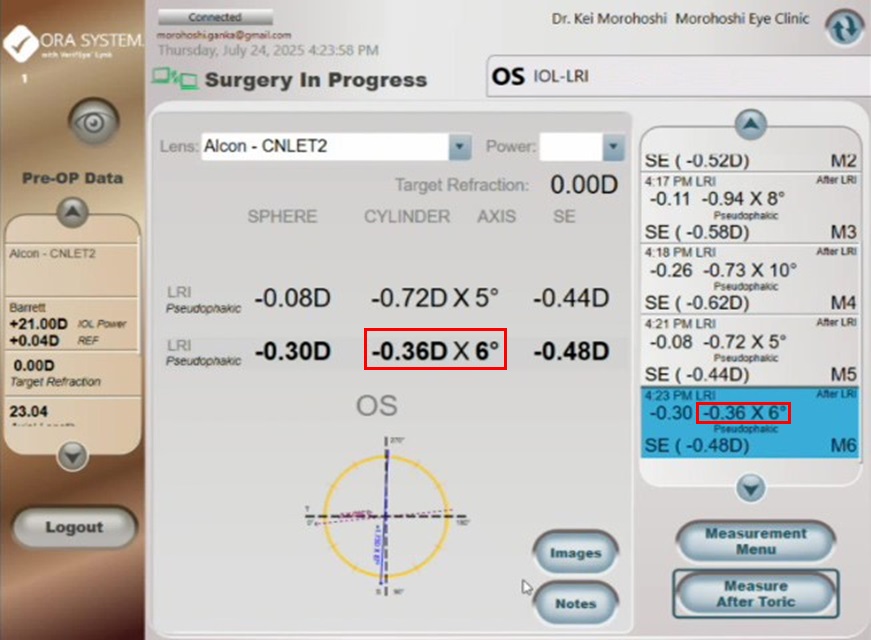
We performed LRI while monitoring residual astigmatism with the ORA system, as shown below. Since his astigmatism was with-the-rule, overcorrection was what we had to avoid, so we started with the incision length calculated from the nomogram and then, as shown below, repeated ORA measurements and additional incisions several times. Taking into account the future shift toward against-the-rule astigmatism with age, we finished with 0.36 D of residual astigmatism (red frame in the figure below).
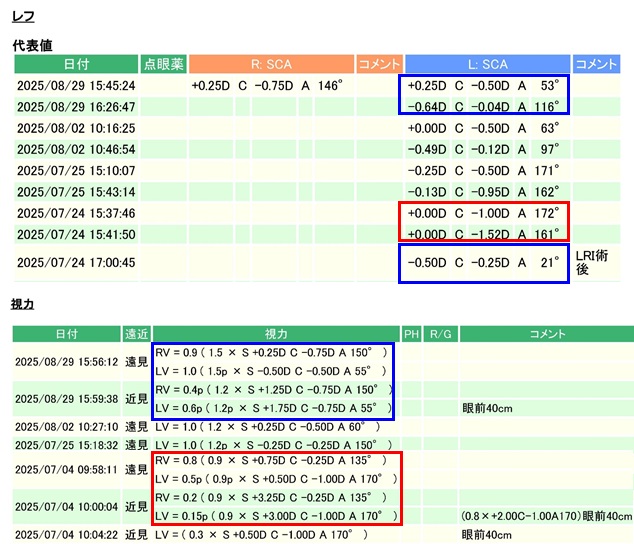
We usually examine patients the day after, one week after and one month after surgery. As shown below, refraction testing showed that astigmatism of 1.0–1.52 D before surgery (red frame on the autorefraction in the figure below) was 0.25 D right after surgery on the same day and 0.50 D at one month (blue frame on the autorefraction in the figure below), and uncorrected vision improved from 0.5p distance / 0.15p near before surgery (red frame on visual acuity in the figure below) to 1.0 distance / 0.6p near after surgery (blue frame on visual acuity in the figure below). He was very satisfied not only with the safety but also with the cost-effectiveness.
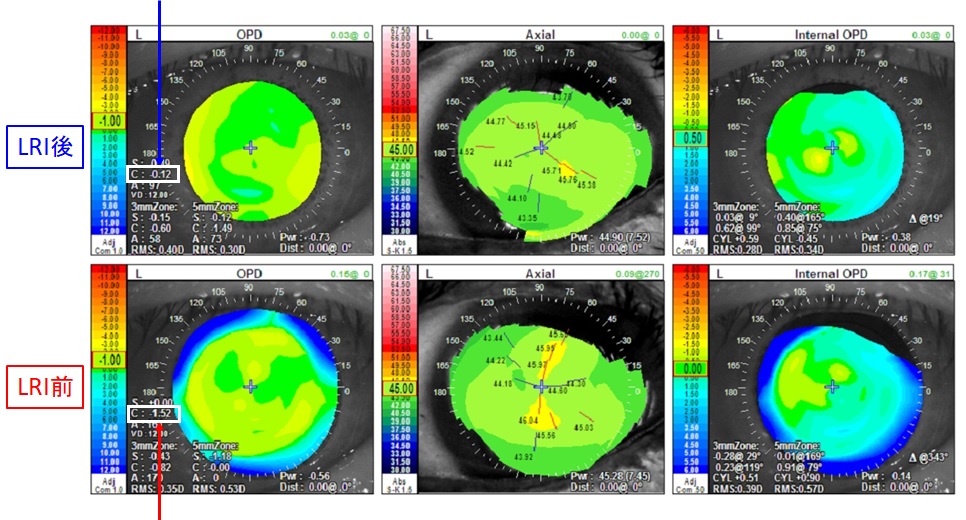
Detailed changes in corneal and total astigmatism were also measured with the OPD-Scan III, shown below. After LRI, the yellow areas of corneal protrusion above and below, at the lower center of the figure, had flattened, and we confirmed that astigmatism had decreased from 1.52 D before surgery to 0.12 D after surgery (white frame on the left of the figure below).
In this patient, the right eye had a longer axial length than the left, and its preoperative refraction was also myopic. If a difference between the eyes was to be created, it might have been smoother to first operate on the left eye set exactly for distance, determine an appropriate shift by postoperative simulation, and then set the right eye slightly toward near, widening the binocular range of clear vision while preserving the preoperative difference between the eyes.
There are arguments for and against same-day bilateral surgery and the need for the ORA system, but in his case I think a better result would have been obtained by operating on one eye at a time and, not limited to the ORA system, performing accurate preoperative tests several times and choosing the lens from multiple test results.
Whether same-day bilateral surgery (Immediate Sequential Bilateral Cataract Surgery: ISBCS) is an advantage or a disadvantage depends on each person's situation. Depending on general health and other factors, same-day bilateral surgery may involve less burden and risk, and it saves time, so if the patient is convinced it may be an advantage. Patients sometimes ask me, "Which do you recommend, doctor?" I myself would want my eyes operated on separately, and as a rule I do not recommend to patients what I would not want done to myself. Our clinic also aims to bring refractive error as close to zero as possible, but it is a fact that when both eyes are done on the same day, there is no guarantee that both can be set exactly on target. And in surgery on a sensory organ, even if the target is hit, whether the patient will be satisfied cannot be known until the patient actually experiences it, so we basically perform Sequential Bilateral Cataract Surgery (SBCS), one eye at a time. I often see discussion of the non-inferiority of results of same-day bilateral surgery compared with one eye at a time, but I also wonder what proportion of ophthalmologists would want same-day bilateral surgery for themselves. That said, we do perform same-day bilateral surgery when patients request it after understanding the advantages and disadvantages above, so please let us know if you wish.
Next, the ORA system. It is a somewhat niche instrument, and having become widespread among facilities that care about precision, it has unfortunately already been discontinued, with development moving to the next system. We have found no reports in Japan of LRI combined with ORA (ORA system-guided LRI) as in this case, but, as with OCT, being able to test and measure in real time is clearly an advantage, and it can be used for purposes other than lens power selection, its original purpose, as here. As a way to improve poor postoperative uncorrected vision due to residual astigmatism with multifocal lenses that have no toric version, or with lenses such as TECNIS PureSee or Odyssey for which a low cylinder power of 1.0 D is not approved, LRI combined with ORA appears useful as a tool that is cheaper, safer and simpler than lens exchange and, depending on the situation, can give a result closer to zero astigmatism. It also serves as a backup test when, as in this case, the need for a toric lens was not accurately assessed before surgery. I have also gone to operate at facilities without the ORA system, so I know from experience that good results can be achieved with accurate preoperative tests even without ORA, and I by no means consider the ORA system essential. However, ORA measurement is non-invasive for patients and involves no additional charge, and since it allows the power to be adjusted during surgery, I feel it is better for patients to have it than not, so we actively use it where it is available. On the other hand, it is also a fact that prediction has its limits. Recently, a special intraocular lens called the Light Adjustable Lens (LAL), whose power can be adjusted with UV light after surgery, is already in clinical use, but it involves restrictions on activity after surgery, and further improvements are expected. Please look this up too if you are interested.
The ORA system was originally intended to verify rather than predict, but prediction accuracy can be improved by repeated optimization with patients' pre- and postoperative data. At our clinic, we improve prediction accuracy by using a regression formula combining results of existing formulas with intraoperative spherical aberration values from the ORA system, but even so, predicting the power exactly is impossible. Recently, therefore, rather than predicting postoperative refraction, we also use logistic regression to judge whether the result will deviate in the plus or minus direction relative to existing formulas. Doctors performing refractive surgery with intraocular lenses will understand that knowing even this greatly improves accuracy and patient satisfaction as a result.
Partly as information sharing, we have presented a case in which residual astigmatism was reduced and uncorrected vision improved by a probably little-known use of the ORA system: LRI combined with the ORA system (limbal relaxing incisions). This case had with-the-rule astigmatism, so we wanted to avoid a shift to against-the-rule astigmatism from overcorrection. Had accurate preoperative testing, including corneal topography, been performed, rather than relying on announcements on social media, and had an appropriate toric lens been chosen based on the results, the postoperative problem might have been avoided; or it might have been unavoidable even so. A better result might have been obtained if the previous clinic had exchanged the lens instead of our performing LRI, and we cannot know what the best rescue for the patient would have been. I have no wish to be the "wise doctor in hindsight," but we learn a great deal from patients in this way, and this case again reminded us of the importance of performing preoperative tests several times with multiple instruments and of accurately interpreting test results. Our clinic will continue to be thorough in the quality of preoperative testing and the lens selection process, and to use intraoperative real-time measurement as a backup, aiming for safer surgery with high reproducibility and precision.
Among postoperative problems, perhaps only a small portion can be solved with LRI, but if you are troubled by poor uncorrected vision due to residual astigmatism, please feel free to consult us.