
This is the second case in Japan of MiniWELL PROXA.
He is a pediatrician (a man in his 50s) who first visited us with a referral letter from a nearby eye clinic, wishing for cataract surgery with multifocal lenses (a soft contact lens wearer). Both eyes had advanced nuclear cataracts of about grade 4 nuclear hardness and extreme myopia (axial length 28.9 mm) with somewhat poor pupil dilation; moreover, he had practiced karate for many years and had seen eye doctors several times for blows to the eye, so besides high myopia, possible zonular rupture from trauma was a concern. Frankly, my first impression as a surgeon was that I would rather not perform surgery with multifocal lenses, which demand accuracy not only in surgical technique but in lens power calculation... On the OPD (wavefront aberrometry), both eyes showed increased internal higher-order aberrations, enough to make the moon look triple, as evidence of advanced cataract (right column and lower left in the figures below), but although corneal spherical aberration was somewhat large, corneal higher-order aberrations were sufficiently small (middle and lower left below). There was also none of the optic atrophy common in highly myopic eyes, and apart from the surgical difficulty of weak zonules and the uncertainty of postoperative refractive error, we found nothing making him unsuited to multifocal lenses, so after fully explaining the risks, surgery was booked.
Right eye preoperative OPD (wavefront aberrometry)
Left eye preoperative OPD (wavefront aberrometry)
In the preoperative questionnaire he checked "frequently" for night driving, and wanted to prioritize uncorrected distance over near vision, but as a pediatrician he also wanted to secure the distance for giving injections to children and babies, so at first we planned MiniWELL. However, before the surgery SIFI MedTech contacted us about monitor use of MiniWELL PROXA, and when we proposed it, he wished for surgery with the WELL Fusion System, using MiniWELL as planned in the dominant eye and MiniWELL PROXA in the non-dominant eye.
First, the target refraction for the dominant right eye was set on the line just short of hyperopia (first minus). From experience, when using MiniWELL in people with high myopia, who already have a deep depth of focus, postoperative satisfaction is higher with a slightly near-side target than aiming for emmetropia (0 D), without much loss of distance vision; so for the right eye's power, since the results of several calculations, including our clinic's own corrected regression formula and the AI-based Kane and EVO formulas, almost agreed, we chose with relative confidence.
Normally cataract surgery on the two eyes is done a week apart, and with domestic lenses, the left eye's lens power can be decided and ordered after assessing satisfaction and refractive error in the right eye, in time for surgery. But MiniWELL is imported from Italy and takes about a month from order to arrival, so the left eye's lens must be ordered in advance to accommodate his wishes. In his case, after right eye surgery, his wish for the left eye's target could be (1) to see further than the right eye, (2) to see nearer than the right eye, or (3) to see the same as the right eye. However, the low-power MiniWELL of +10.0 D or less used in highly myopic (long) eyes is made only in 1.0 D steps, giving few power options, so to be safe we also ordered the toric MiniWELL Toric, made in 0.5 D steps; in other words, we went into surgery fully prepared, ready for three patterns, including the possibility of MiniWELL in both eyes.
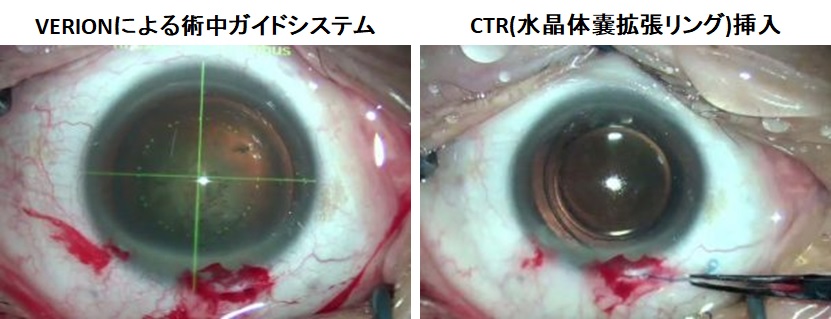
The right eye first: for MiniWELL, we set the anterior capsulotomy (CCC) diameter of the VERION intraoperative guidance system slightly smaller (left below). Zonular weakness during surgery was not enough to displace the capsulotomy edge, but we also inserted a CTR (capsular tension ring) to reinforce the zonules and prevent lens decentration from capsular contraction, and the surgery was completed without trouble (right below).
After surgery he was satisfied with very good vision of 1.2 distance / 1.2 near uncorrected, but for the left eye, planned for PROXA, he unexpectedly wished to see further if possible, so without hesitation we used the MiniWELL PROXA prepared for case (1), seeing further than the right eye.
As the internal higher-order aberration values in the OPD above show, the left eye's cataract was harder and its zonules weaker, but again with a CTR the surgery was completed safely, and after surgery he was very satisfied here too with 1.2 distance / 1.2 near uncorrected. Vision at 30 cm was also 1.2, and at a postoperative visit he was delighted, saying, "I could see clearly right down to the needle hole in a child I'd given an injection!"; the stress at work also seems to have eased.
At present there are still only two cases of MiniWELL PROXA in Japan, including this one, and knowing this, he provided information very proactively from a physician's standpoint, so please do refer to his survey answers.
*As for his final comment, "To fussy people full of demands, I definitely recommend multifocal lenses (lol)!", please note that such people are the classic example, at cataract surgery meetings, of those unsuited to multifocal lenses (sweat).
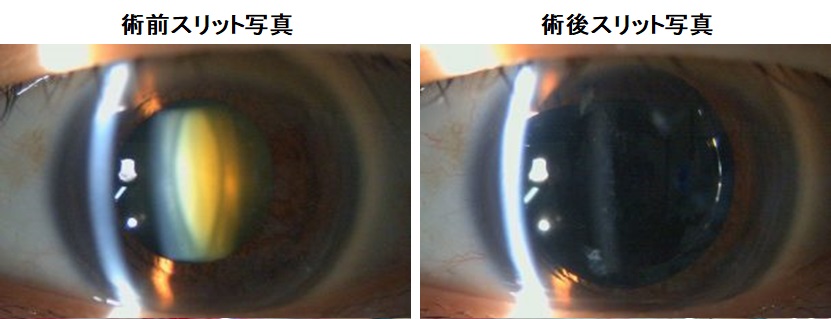
The figure below is a postoperative retroillumination image of MiniWELL PROXA. Differences in aberration appear as stripes, so I asked him, as he drives at night frequently, in detail about differences in halos and glare between his eyes. He said, "Hardly any difference, but if I cover each eye in turn and look at car headlights, if anything the left eye's PROXA has slightly more halo, or light spreading, than the right eye's MiniWELL. But if MiniWELL is zero, PROXA is about 1 on a scale of 10. Apart from car headlights I can hardly tell the difference." At first glance PROXA's stripes may look like a diffraction grating, but they are just differences in aberration appearing as stripes, and seemed to have almost no effect on increasing halos and glare. Our experience with PROXA is still only two cases, but it reconfirmed that PROXA's ability to improve near vision without sacrificing MiniWELL's characteristic of being "a multifocal lens that sees almost like a monofocal" is genuine.
<MiniWELL PROXA retroillumination image>
As the appearance of MiniWELL PROXA shows, multifocal lens performance is advancing rapidly, with the range of vision, especially the near focus, extending ever closer; but the currently dominant diffractive lenses have not overcome the drawback that as the range of focus from far to near increases, halos and glare inevitably increase too. In that respect MiniWELL PROXA, with its unique design that extends depth of focus using aberrations, largely cancels out that drawback, and in future lenses with non-diffractive structures like MiniWELL may increase. In fact, besides J&J's TECNIS Eyhance, ALCON's AcrySof IQ Vivity in the US (left below), with an add of about +1.5 D, is said to have almost none of the halos and glare of diffractive lenses, with reported vision of 0.8 at 26 inches = 66 cm, the desktop computer distance for Westerners, and 0.625 at 16 inches = 40 cm, the mobile phone distance (right below). Unfortunately it is not yet approved by the Ministry of Health, Labour and Welfare, so its introduction in Japan seems some way off, and it is also undecided whether it will be treated as monofocal, like TECNIS Eyhance with its +0.5 D add, covered by insurance as a multifocal lens, like LENTIS Comfort with an almost identical add (+1.5 D), or a multifocal lens under the elective treatment system, like PanOptix and TECNIS Synergy.
<ALCON AcrySof IQ Vivity>

I have strayed onto other lenses, but our monitor use of MiniWELL PROXA ended with very good results in both cases, and it was finally officially released for general use in Japan the other day. From now on, anyone who wishes can use it if they are a candidate. Reports on MiniWELL PROXA use are still few worldwide, and candidacy must be judged and the lens used appropriately with care, but I did feel the need for different target refraction settings from conventional MiniWELL, so we will continue to provide information to raise everyone's postoperative satisfaction.
Thanks to the cooperation of the import agent, our clinic plans to offer it at the same price as standard MiniWELL, so if you are interested, please feel free to consult us.
2021.09.29