
A city health check had pointed out cataracts about three years earlier and she had been seeing a nearby clinic, but in the past two to three months the haziness had progressed further, so she first visited us for surgical consultation.
Both eyes had cataracts mainly of cortical opacity; her eyes were somewhat short but had become mildly myopic, and vision was relatively good, 0.6–1.0 at distance and about 0.5–0.7 at near. Even so, in the preoperative questionnaire she wished for surgery with multifocal lenses, prioritizing being able to drive without glasses, and said reading is her hobby. She also drives at night, and I was thinking PanOptix, with fewer halos and glare than Synergy, would suit her better, when the new MiniWELL, MiniWELL PROXA, became available; when we proposed it, she was keen to have it. It was the first use in Japan, a very new lens with few reports of use even worldwide, and not covered by the elective treatment system, so it would be fully self-paid; the surgery went ahead with her understanding of these points.
Since it was a new lens with little information, we held a web meeting in advance with staff of SIFI MedTech in Singapore, which distributes MiniWELL, decided the lens powers to use, and ordered lenses including backups.
As the WELL Fusion System® recommends, using MiniWELL in the dominant eye and MiniWELL PROXA in the non-dominant eye, we first operated on the dominant eye (MiniWELL). The surgery itself was completed without trouble, and since we had set the target power considering the refractive error typical of short eyes, there was almost no power deviation after surgery. After surgery she was satisfied with very good uncorrected vision: 1.5 at distance, 1.5 at 40 cm, and 0.8 at 30 cm.
Normally, after surgery on one eye, we discuss and decide "where to put the focus of the next eye relative to the operated eye (the same? slightly further? nearer?)" (staged implant), but she was already satisfied at both distances with the dominant eye's MiniWELL, so after discussion she agreed that the non-dominant eye's MiniWELL PROXA would also be set without sacrificing distance vision, and surgery went ahead.
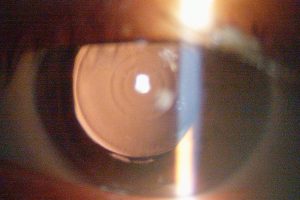
It was my first time using MiniWELL PROXA too, and when it came to inserting the lens, I felt its central ring-shaped add area was somewhat more conspicuous than MiniWELL's, and was concerned that some halos might occur after surgery. For reference, the figure below shows the lenses at a postoperative examination: the right eye's MiniWELL cannot be told apart from a monofocal, but the left eye's MiniWELL PROXA shows two rings in the center (pupil dilation somewhat poor).
Right eye: MiniWELL Left eye: MiniWELL PROXA

Surgery on the non-dominant eye with MiniWELL PROXA was also completed without problems, and in postoperative testing she was very satisfied with uncorrected vision of 1.2 at distance, 1.5 at 40 cm, and 1.5 even at 30 cm, good near vision just as PROXA's specifications promise. She said she felt no difference between the eyes in halos and glare, which the lens design had made me worry about, and none at all on the PROXA side; personally, I thought that in that case even PROXA in both eyes might be fine. Also, PROXA's defocus curve seemed somewhat weaker at about 1 m, so with her cooperation we also tested vision at 1 m: 1.5 in the right MiniWELL eye and 1.0 in the left MiniWELL PROXA eye, a slight edge to MiniWELL, though she did not notice the difference. When I asked her, "Is there anything you notice differs between your eyes?", she said, "The left eye with MiniWELL PROXA really does see near very well!"; so the expected effect of a design prioritizing near had appeared, and I felt that MiniWELL PROXA's ability is genuine.
For reference, part of a 30 cm near vision chart is shown below; the text size of our clinic's website viewed on a mobile phone is roughly 0.15–0.2, I suppose? Incidentally, to me the 1.5 Landolt ring looked so small I wondered whether a speck of dust had landed on it, and I was amazed that it can be seen with MiniWELL PROXA.
30 cm vision chart and an iPhone 7 Plus screen
The 1.5 Landolt ring on the 30 cm chart compared with a 10-yen coin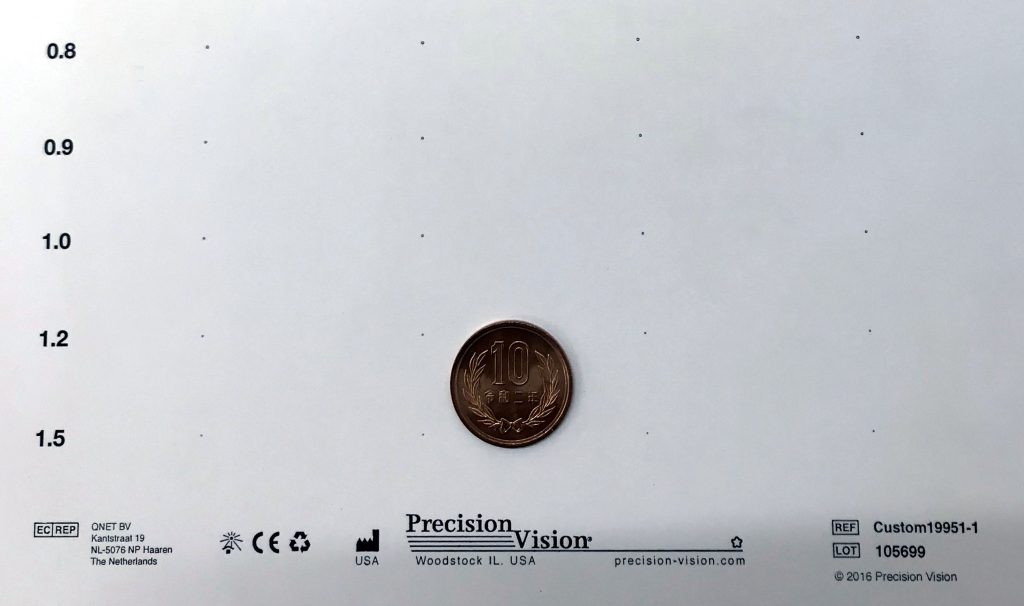
MiniWELL PROXA is a lens with still few cases worldwide, and this case is the first use in Japan; setting target powers suited to Japanese patients may require experience and know-how, but it is very reassuring that the technology developed with MiniWELL is reflected in it. Being a lens that sees at 30 cm with almost no halos or glare is very distinctive, so I expect the number of people wanting it to grow. If you are interested, please feel free to consult us.
2021.08.16