
We have been using TECNIS PureSee ahead of its general release since July last year, and a patient scheduled for surgery at our clinic asked us directly to publish a PureSee case. Having confirmed a postoperative course of more than six months, we present this case, including points to watch in actual clinical practice. We have deliberately chosen a standard case without special features.
The patient had already been told she had cataracts by her previous doctor and wanted to check their progress, including whether surgery should be done soon. She first visited us without a referral letter in March 2025. Both eyes were hyperopic, with cataracts consisting mainly of cortical opacity, and corrected visual acuity had fallen to 0.6 in the right eye / 0.7p in the left eye. Even with a monofocal lens, surgery would at least make nothing worse than at present, and could be expected to improve her quality of life (QOL).
However, cataract is not an emergency, so in line with our clinic's policy we did not strongly recommend surgery and told her she could have it whenever she wished. Since her previous doctor could also perform the surgery, we ended the first visit by asking her to consult us again at a return visit if she wanted surgery at our clinic.
Two months later, in May, she returned wishing to have surgery, and said she would like to consider multifocal lenses if she was a candidate. Corneal topography showed low higher-order aberrations, so we explained that, as long as no refractive error occurred, her eyes were ones in which any type of multifocal lens could deliver its intended performance. We then gave her a questionnaire and asked her to choose the lens type according to her own priorities.
In the questionnaire she said that "I don't mind wearing glasses for near when needed, so I want to see sharply," and "distance is my top priority; I want to play tennis, my hobby, without glasses." As lenses that prioritize quality of vision over range of focus, we decided to have her choose between two extended depth of focus (EDOF) lenses: TECNIS PureSee and Clareon Vivity.
The choice between these two EDOF lenses ultimately depends on each patient's situation. In her case, before the cataracts her right eye had been slightly more myopic than the left (the right eye's axial length is 0.4 mm longer), so if she was satisfied with the left eye, she wanted the right eye set slightly toward near if possible. Since setting the right eye toward near was assumed from the start, we suggested that PureSee, which tolerates refractive error, that is, whose distance vision is less likely to drop even when shifted toward near, might be more suitable, and she agreed.
Before setting the target refraction, a word about the characteristics of power selection for PureSee. As we wrote previously about the characteristics of power selection that derive from its structure (Japanese), PureSee does have the tolerance to refractive error described above. Because of this, from 8 months of experience, I feel that choosing the target power has both easy aspects and difficult aspects (individual variation) compared with usual multifocal lenses.
The easy aspect is that choosing a lens power to achieve distance visual acuity of 1.2 is even easier than with a monofocal lens, i.e., more forgiving. In other words, distance vision is easily maintained even if some power deviation occurs; being a safe lens for patients is an advantage, and it is also easy for surgeons to use. On the other hand, some patients who come to us ask for the target to be "exactly zero" and try to choose the power themselves from the lens power calculation sheet. With PureSee, however, choosing the lens that targets 0.0 D on the calculation sheet tends, in many cases, to result almost certainly in mild hyperopia, so care is needed. Distance vision may still be 1.2 or better as a result, but needing a plus lens (very mild reading glasses) at full correction means that a more appropriate power choice could have allowed closer vision without reducing distance vision. The optimal target depends on each patient's conditions, so we do not recommend choosing the power yourself based only on information from social media and similar sources. We recommend that you convey your wishes accurately to your doctor and leave the decision to the specialist.
With this in mind, back to power selection for the left eye. Her left eye had been emmetropic before the cataract, so we aimed for exact distance focus and, as shown on the left of the figure below, prepared two lenses for surgery: a +21.0 D lens targeting −0.22 D (1/0.22 = 4.55 m) and a +21.5 D lens targeting −0.56 D (1/0.56 = 1.79 m).

In left eye surgery, after removing the lens we selected the power, as usual, based on intraoperative wavefront measurements with the ORA system. This time we targeted 0 D, exact distance focus, as subjective refraction, and used a +21.5 D lens. In other words, this lens was calculated to leave myopia of −0.56 D by the preoperative tests and as much as −0.87 D by the intraoperative measurement shown below.

Even so, subjective refraction on the day after surgery was +0.375 D, slightly hyperopic, as shown for 8/22 in the figure below. Distance vision was good at 1.2, but near vision was 0.5, somewhat poorer than the specifications would suggest. Near vision improved to 1.2 with a +3.25 D lens, so my impression at this point was that she was not yet making good use of PureSee's near add.
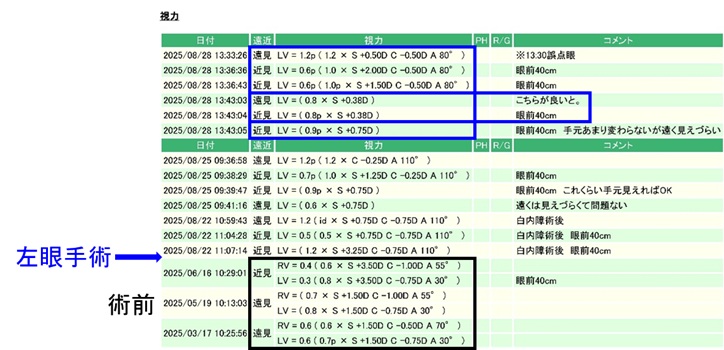
One week later we operated on the right eye. The left eye's objective refraction was −1.375 D, but its subjective refraction was +0.25 D, still slightly hyperopic, and as originally planned she wished the right eye to be shifted slightly toward near. Just before right eye surgery, we therefore simulated in the left eye how things would look if shifted toward near by +0.38 D and +0.75 D. As shown in the blue frame in the figure above, a 0.75 D shift improved near vision to 0.9p but made distance harder to see, so she chose the 0.38 D shift toward near, expected to give 0.8 distance / 0.8p near.
This method, which our clinic has used for some time, of running a simulation in the eye already operated on to determine the appropriate target refraction for the fellow eye actually has a name: the FEST (Fellow-eye Self-Tuning) method.
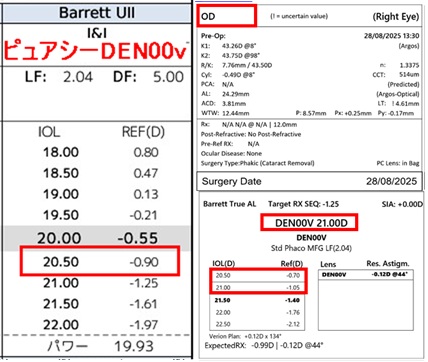
Based on the FEST result, we went into surgery planning to use a +20.5 D lens targeting −0.90 D (1/0.90 = 1.11 m), shown on the left of the figure above, so that the right eye's target would be about −0.56 − 0.38 = −0.94 D. As shown below, the power predicted by intraoperative measurement with the ORA system was also −1.12 D, showing the same difference between the eyes as the preoperative tests and the left eye's intraoperative measurements, so we confidently used the planned lens and completed the surgery without problems.


On the day after surgery, distance vision was 1.5p, but near vision was again somewhat poor at about 0.5p. After that, however, as with the left eye, near vision gradually improved, finally reaching about 1.2 distance / 0.9 near. The result was micro-monovision with a 0.50 D difference; distance vision did not drop as much as in the preoperative FEST simulation, near vision was even better, and the patient was satisfied (black frame in the figure below).

In response to the request, we have presented a standard PureSee micro-monovision case. As shown above, PureSee is easier to handle than a monofocal lens when it comes to securing distance vision, but my impression is that individual variation in its near vision is larger than with Vivity. In fact, as you may have noticed, the difference between subjective refraction (figure above) and objective refraction (figure below) is large and not constant, which is one reason optimization is difficult.
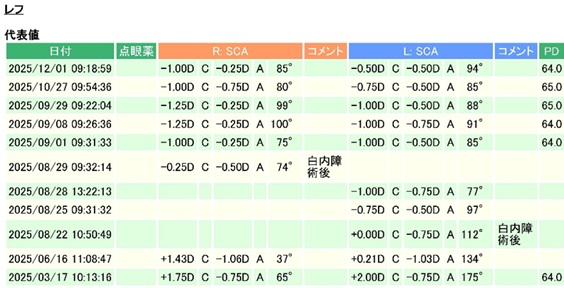
For this reason, the appropriate difference in power for improving near vision without reducing distance vision is not uniform either, and I feel this is a lens for which individual optimization is especially important. This is the "difficult aspect" mentioned above, namely the size of individual variation. Usually we often operate first on the eye with the more advanced cataract, while considering eye dominance and differences in refraction. With PureSee only, however, if conditions allow, our clinic first operates on the eye in which we want to secure distance vision, then sets the fellow eye's power with the FEST method. The reason is that a certain number of patients are fully satisfied at both distance and near without any shift toward near. Setting an eye toward near from the start would mean losing the chance that they could have been satisfied with more natural vision. We place importance on keeping that possibility open as far as possible while finding the best balance for each patient.
And the appropriate power difference for each patient can, in part, only be known after seeing the postoperative course of one eye; unfortunately it cannot be predicted before surgery. In the sense of making the most of its tolerance to refractive error, we therefore consider PureSee to be one of the lenses least suited to same-day bilateral surgery. Of course, for people who are fully satisfied if both eyes can see at distance plus a little more, distance vision is easily maintained even with some power deviation, so it may be a lens with high safety even in same-day bilateral surgery.
The left eye in this case is a TECNIS PureSee case in which 0 D was targeted strictly as subjective refraction. Had we chosen the lens targeting 0 D on the lens power calculation sheet, I believe the eye would have become hyperopic and near vision at 40 cm would have been 0.5 or worse. From the standpoint of ocular optics, bringing refraction closer to 0 D may make the most effective use of light energy, maximize contrast, and minimize photic phenomena caused by defocus. The price, however, may be losing the advantage of tolerance to refractive error (≈ range of focus), a key feature of PureSee. If a plus lens is needed at subjective full correction, that is, if residual refraction is hyperopic, the eye cannot truly be regarded as exactly 0 D.
In cataract surgery, being technically accurate and consistent is of course important, but I feel that what matters most in producing a difference patients can actually feel is how accurately the power can be chosen to match each patient's wishes. That is also the hardest part for surgeons, so it is natural that patients do not know which power is right for them. At our clinic, we take into account eye dominance, differences in axial length and corneal power between the eyes, and differences in preoperative vision and refraction, and use multiple axial length devices and calculation methods to propose an appropriate, evidence-based power. To repeat: TECNIS PureSee appears to be a lens that is "more forgiving than a monofocal lens in terms of securing distance vision, while individual optimization is important in terms of how much near vision can be drawn out." Please do not try to decide everything yourself from the start; first, feel free to consult us.
2026/03/11