
Once again in response to requests, here is a TECNIS PureSee case, this time in a highly myopic patient.
The patient had been receiving eye drop treatment at another clinic for early glaucoma or optic nerve hypoplasia, and after moving she first visited us in March 2024 with a referral letter.
We continued the eye drops prescribed by her previous doctor and followed her with regular visual field tests. Her intraocular pressure was low to begin with, and we saw no progression at all in visual field abnormalities or in thinning of the nerve fiber layer. As the referral letter also noted, optic nerve hypoplasia rather than glaucoma was therefore a possibility, and we continued to observe her without needing to add more eye drops.
Later, partly because of her high myopia, her cataracts gradually progressed. Although corrected visual acuity was relatively preserved, she was bothered by blurred vision and reduced contrast, and in September 2025 she booked surgery.
Wishing for multifocal lenses despite glaucoma treatment
Since she was already being treated for glaucoma, we naturally assumed at first that surgery would be with monofocal lenses, but she told us, "If possible, I'd like to use multifocal lenses."
In the preoperative questionnaire, her priority of distances was near > intermediate > far, and she had chosen:
"I don't mind wearing glasses when looking very far away, so I want to get by without glasses in daily life."
So if she did not have glaucoma, we would have wanted a lens of trifocal or higher, giving good near and intermediate vision, as the first choice.
In this case, however, we had to consider the loss of sensitivity if glaucoma were to progress in the future, so we recommended a multifocal lens with almost no light energy loss, one of the following
extended depth of focus (EDOF) lenses:
• Clareon Vivity
• TECNIS PureSee
However, the range of an EDOF lens is basically distance to intermediate. It therefore does not fully meet her wish to "see up close without glasses, too."
So this time we decided to set the non-dominant eye toward near to secure intermediate and near vision, and suggested that, if an eye is to be set toward near from the start, TECNIS PureSee, whose distance vision is less likely to drop, might be more suitable.
Wishing for simultaneous glaucoma surgery
We also suggested performing ab interno trabeculotomy at the same time as cataract surgery.
The reasons were that we could expect:
• the possible elimination of eye drops after surgery
• shorter total surgery time by combining the procedures (cataract surgery + 1–2 minutes)
• a cost advantage (the cataract surgery fee is halved).
She had long been a highly myopic contact lens wearer and, unlike her initial wish, was worried about losing the ability to see up close without glasses. We therefore decided to operate first on the non-dominant right eye, set toward near.
First, setting the right eye toward near
As for the target for the right eye, as described in Case No. 96, it is usually easier to adjust the difference between the eyes to suit each patient if the eye set for distance is operated on first. When near vision is prioritized first, as in this case, choosing the appropriate power is therefore more difficult.
To choose just the right power, one that does not create too large a difference between the eyes yet secures satisfying near vision, many factors must be considered together. This differs from patient to patient and should ultimately be decided by the doctor, so we omit the details here.
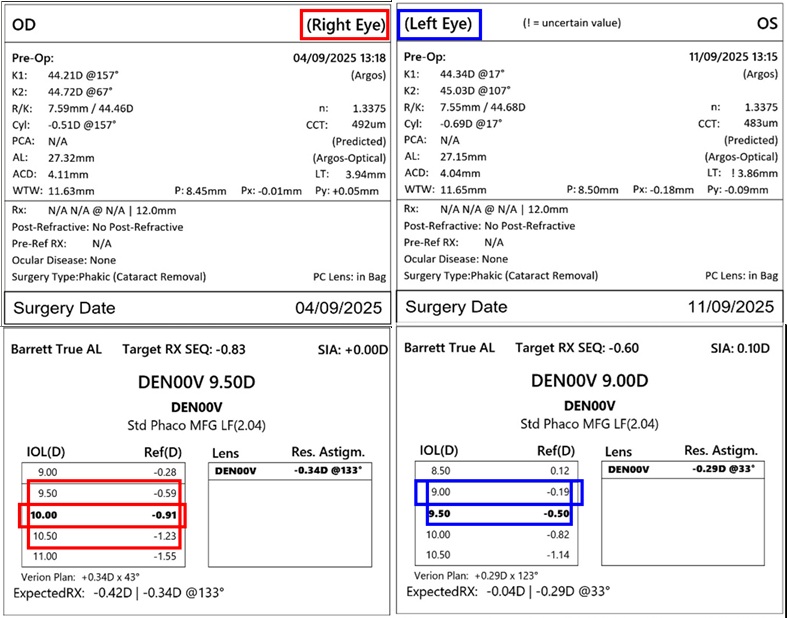
For right eye surgery, we prepared three lenses from the preoperative results (left side, inside the red frame in the figure above):
• +9.5 D targeting −0.59 D
• +10.0 D targeting −0.91 D
• +10.5 D targeting −1.23 D
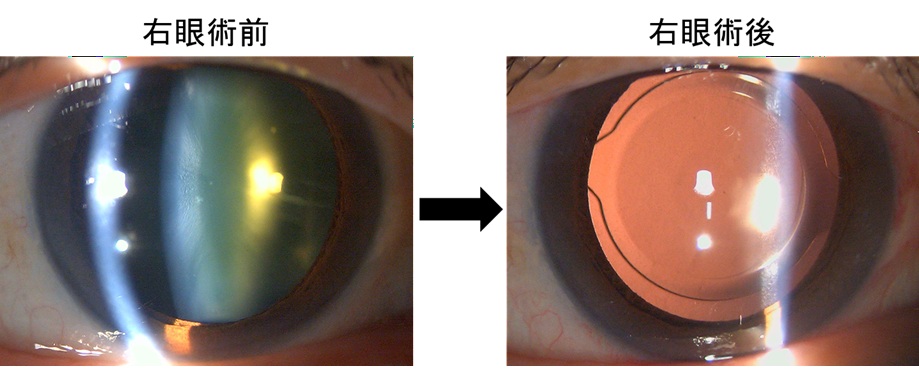
In the end we chose the +10.0 D PureSee, for which intraoperative measurement with the ORA system (below) predicted a refraction of −1.12 D, also performed ab interno trabeculotomy, and completed the surgery without problems.

Although we used a lens targeting considerably toward near, as above, uncorrected vision on the day after surgery was
1.5 distance / 1.0p near, slightly more toward distance than expected.
By day 4, however, the eye had shifted slightly toward myopia as expected (refraction usually shifts toward myopia over time), to
0.9 distance / 1.2 near, and she was relieved to find near vision as easy as she had aimed for before surgery.
Adjusting the optimal difference for the left eye with the FEST method
Next, the left eye.
She was fully satisfied with near vision in the right eye, so she wanted the left eye set slightly toward distance. For the left eye, opposite to Case No. 96, we therefore examined the optimal difference between the eyes with the FEST (Fellow-eye Self-Tuning) method using minus lenses (lenses that shift toward distance).
At our clinic we check with the FEST method
• on day 4 after surgery
• one week after surgery (= just before surgery on the fellow eye)
and make the final decision on a difference between the eyes that satisfies each patient.
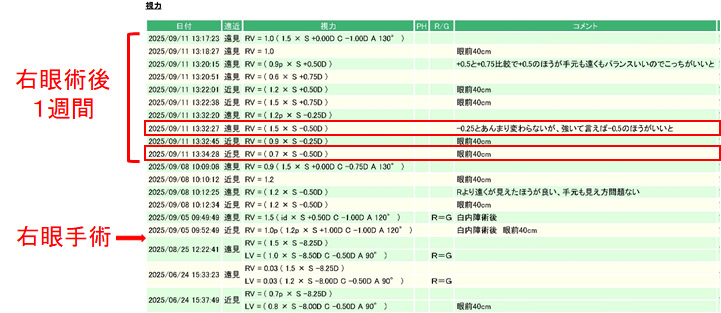
In this case she chose a power shifted 0.50 D toward distance, which in the simulation gave 1.5 distance / 0.7 near (red frame in the figure above).
For left eye surgery, based on the preoperative tests (blue frame on the right of the power calculation sheet above), we prepared two lenses:
• +9.0 targeting −0.19 D
• +9.5 D targeting −0.50 D
Judging only from the preoperative tests, we had planned to use +9.5 D targeting −0.50 D. In the end, however, as shown below, we used the +9.0 D PureSee, for which the ORA system predicted a refraction of −0.52 D, again added trabeculotomy, and completed the surgery without problems. This choice also took into account the risk of a myopic shift due to the long axial length and somewhat high corneal power, and the fact that preoperative testing with another instrument gave a target refraction of −0.60 D for +9.0 D.

This left eye thus represents the usual way of using PureSee, set exactly for distance.
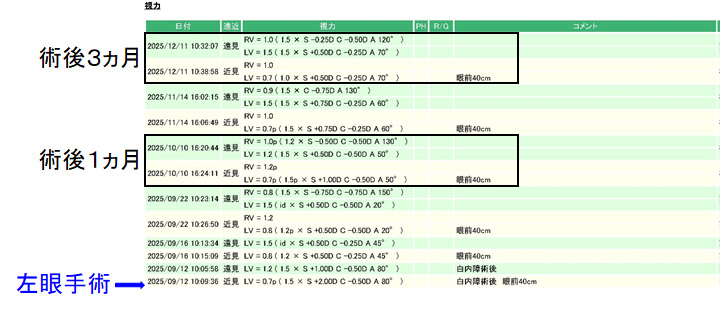
Uncorrected vision on the day after surgery:
1.2 distance / 0.7p near
On day 4, as in the simulation:
1.5 distance / 0.8 near
At 3 months:
1.5 distance / 0.7 near
Vision stabilized, and at 3 months the result was mini-monovision with a 0.875 D difference, as shown below; she was satisfied with life without glasses using both eyes.
Freedom from glaucoma eye drops as well
Finally, regarding pressure lowering from the glaucoma surgery: as shown below, glaucoma eye drops have been stopped since surgery, yet intraocular pressure remains at the same level as with the drops. She was therefore also delighted to be free of eye drops.

With ab interno trabeculotomy, pressure reductions of roughly 4–10 mmHg have been reported, depending on the preoperative pressure and whether other surgery is combined. In cases combined with cataract surgery in particular, the reduction is often around 4–6 mmHg. Because the aim of the surgery is to reduce resistance to outflow of the aqueous humor (the fluid inside the eye), in theory the pressure cannot fall below episcleral venous pressure (about 8–11 mmHg), where the aqueous drains. This is why several other glaucoma surgical methods also exist.
Besides surgery and eye drops, pressure-lowering treatment also includes selective laser trabeculoplasty (SLT), but cataract surgery alone can be expected to lower pressure by about 1.5–2.5 mmHg. For this reason, we usually do not perform SLT before surgery in people who are scheduled for cataract surgery. It is often more rational to see the effect of cataract surgery first and then judge whether additional treatment is needed. For people already using glaucoma eye drops, our clinic sometimes explains the cost advantage and offers combined ab interno trabeculotomy as an option. Indeed, there are reports that combined cataract and glaucoma surgery is more favorable than cataract surgery alone in terms of pressure and the number of eye drops.
Summary
We have presented a mini-monovision case using TECNIS PureSee in a highly myopic eye under glaucoma treatment, operating first on the non-dominant eye set toward near.
We recently learned that TECNIS PureSee finally received US FDA approval on March 12, 2026. In the US, EDOF lenses are a separate category and must meet criteria, such as quality of vision, that are harder to quantify than for trifocal lenses. I suspect that one reason approval took time may have been individual variation among patients in visual function, but this is only my personal speculation.
In any case, the FDA has now accepted TECNIS PureSee's laboratory data and real-world clinical data. We will continue to update reports of its use and satisfaction surveys from the US, where people travel by car more (so photic phenomena at night may matter more than in Japan) and where reading distance may differ (possibly longer than for Japanese people, given differences in physique).
2026.03.15