
Three months have passed since the general release of TECNIS PureSee, but little information, including at academic meetings, has come out about appropriate target power setting in real practice, so first we present a showcase PureSee case.
He first visited us in February 2025 with a referral letter from his regular doctor at another clinic, because of reduced vision from a cataract in his left eye.
As the referral letter said, a posterior subcapsular cataract had advanced in the left eye only, and corrected visual acuity was below 0.3; he wished to have surgery from the first visit. The right eye also had reduced vision from cataract, though milder than the left, so after discussion, also considering his age, he booked cataract surgery on both eyes, left → right.
In the preoperative questionnaire he chose a priority of far > intermediate > near and "I don't mind wearing glasses; I want to see sharply," and for his personality he checked perfectionist, so we decided to consider mainly monofocal lenses. He said he was also considering multifocal lenses but wanted to avoid diffractive ones. Wanting to widen the range of focus even slightly without losing quality of vision, he was finally torn between TECNIS Eyhance, a monofocal plus (enhanced monofocal) lens, and Clareon Vivity, an extended depth of focus multifocal lens. He first chose Eyhance for the left eye, and for the right eye we decided to consider, depending on near vision after surgery, either mini or micro-mini monovision with Eyhance, or hybrid monovision (monofocal in one eye, multifocal in the fellow eye).
Next, setting the target power. When we asked in detail, distance was his top priority, but he has no occasions to drive at night and wished to see at least a little intermediate to near, rather than infinite distance. Axial length was average at 23.67 mm, but corneal power was somewhat flatter than usual at 42.83 D, so in view of the risk of a hyperopic postoperative refractive error, we set the target with emphasis on distance while also comparing results with ARGOS, an axial length device using segmental refractive indices.
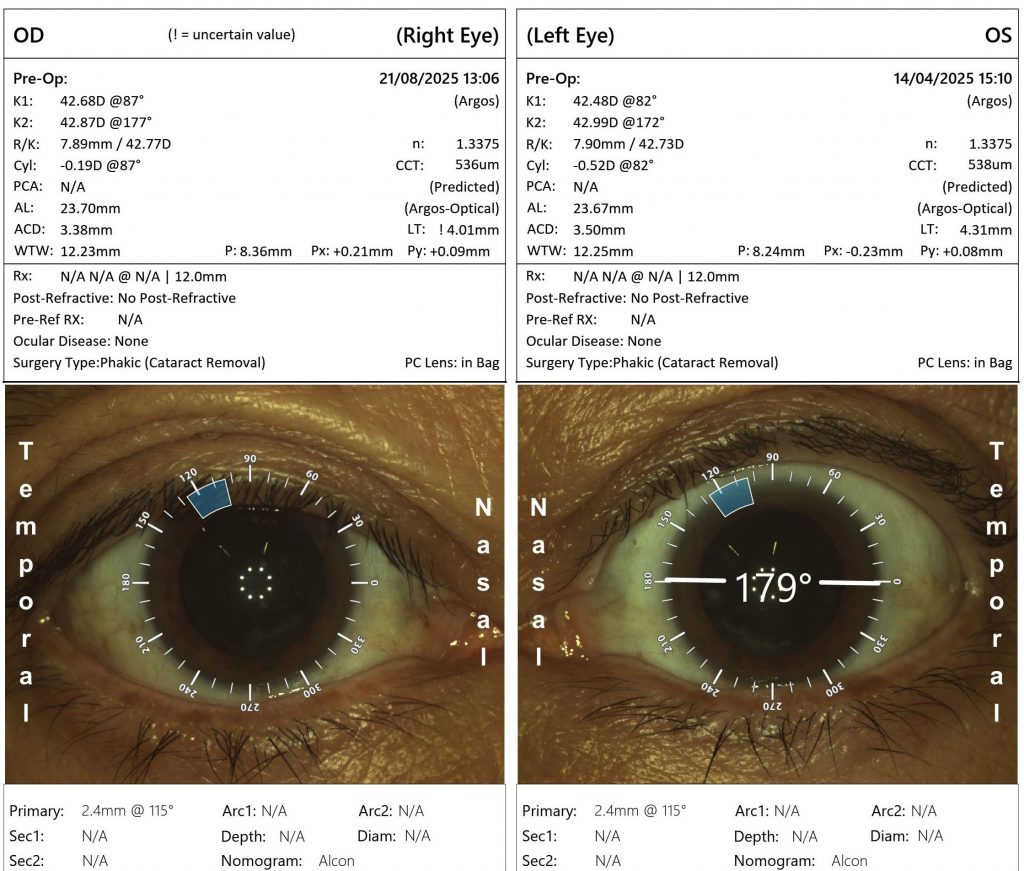
For left eye surgery, since the cataract had advanced in one eye only, we prepared for possible zonular weakness from trauma, but there were no problems. We decided the lens power with reference to intraoperative wavefront aberrometry with the ORA system, and the surgery was completed without problems.
At one week, uncorrected vision was 1.5p distance / 0.7 near; he was pleased with near vision better than expected, and for the right eye he wished for micro-monovision with the same Eyhance as the left eye, shifted slightly toward near.
Then came right eye surgery, but on the day of surgery he felt unwell on the way to the clinic, and right eye surgery was unexpectedly postponed by four months. During follow-up of the left eye, uncorrected vision was somewhat unstable but generally ranged from 1.2p–1.5p distance / 0.7p–0.7 near, and his wish to see better up close than with the left eye was consistent.
During that follow-up period, the extended depth of focus (EDOF) TECNIS PureSee became available for early use, so we proposed, as an option if micro- to mini-monovision with Eyhance would not satisfy him, hybrid monovision using not Vivity but PureSee, on the same TECNIS platform as Eyhance, and he decided to consider it.
As a simulation of micro-monovision with Eyhance, we added lenses of +0.25 to +0.75 D in front of the left eye and measured distance and near vision. With +0.50 D added (a 0.50 D shift toward near), distance vision fell to 1.0 and near vision rose to 0.8, but he wanted to see closer still. He understood that raising near vision without further reducing distance vision would be difficult with Eyhance, and decided to consider Eyhance and PureSee. He then deliberated for more than a month, right up to the lens ordering deadline, and finally called to say, "I've decided on TECNIS PureSee."
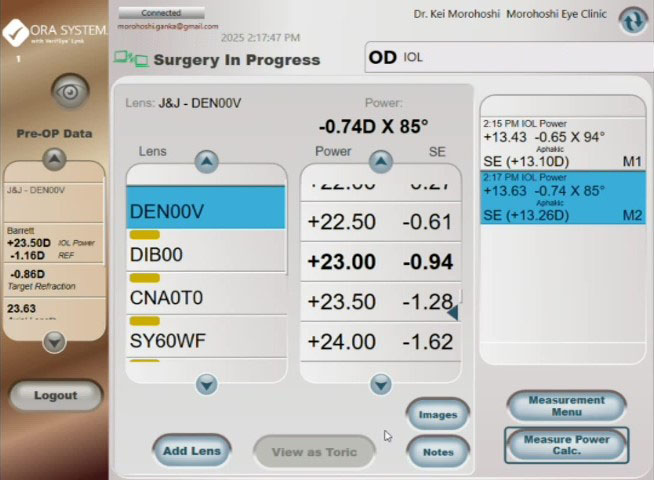
Next, setting the target power for the right eye (= deciding the lens power). Referring to the simulation results in the left eye above and taking PureSee's characteristics into account, we calculated the optimal power to give better near vision than the left eye without reducing distance vision, and prepared several powers for surgery, including a lens of the same power as the Eyhance in the left eye.
TECNIS PureSee is not yet optimized in the ORA system, so, as shown below, we also displayed results for Eyhance and Synergy, lenses on the same platform that are already optimized, and after some deliberation decided the lens power. The surgery was completed without problems.
After right eye surgery, uncorrected vision was 1.5 distance (no improvement with correction) / 1.0p near (1.2). He was satisfied with near vision better than the left eye, as he wished, and with distance vision better than expected, and was delighted with a glasses-free life with both eyes.
Setting the target power for TECNIS PureSee differs greatly from usual lenses, so finally a few words on its characteristics and points to note in power selection. We will not disclose the lens power and target refraction used in this case, to avoid misleading anyone, but from our experience so far, near vision beyond the specifications cannot be expected with usual power selection. J&J recommends the "first minus" (the lens power on the myopic, minus side closest to a 0 D target: in the left column of the figure below, +22.5 D targeting −0.10), though without explaining the theoretical basis. I was somewhat worried that blindly trusting this in choosing the power might harm patients, so, as described here (Japanese), our clinic began using PureSee after exploring the optimal power selection based on the lens's structural characteristics.
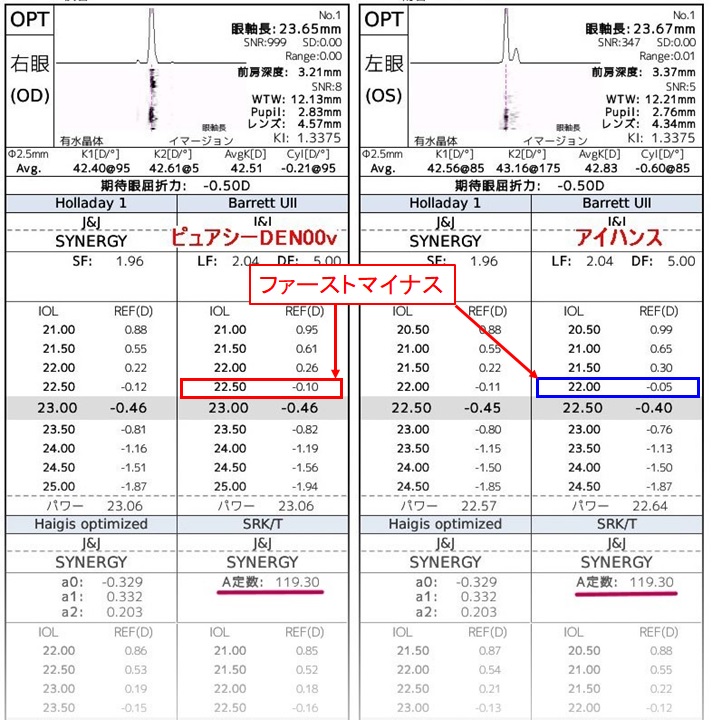
This gets a little technical, but usual power calculations use a lens-specific constant called the A-constant (mainly reflecting where the lens sits in the eye). TECNIS OptiBlue, Eyhance, Synergy, Odyssey and PureSee, which share the same platform (base monofocal lens), all have the same A-constant (119.30), but my personal impression is that PureSee's A-constant differs from that of the other TECNIS lenses.
To repeat, looking at the PureSee power map below, only a very small part of the optic of a +20.0 D PureSee actually has the nominal +20.0 D power. If the manufacturer explained, with clinical and laboratory data (for example, that using it as +20.0 D gives the highest contrast and MTF and the fewest photic phenomena), the basis for selling it as +20.0 D nonetheless, we ophthalmologists should be able to use PureSee with confidence.
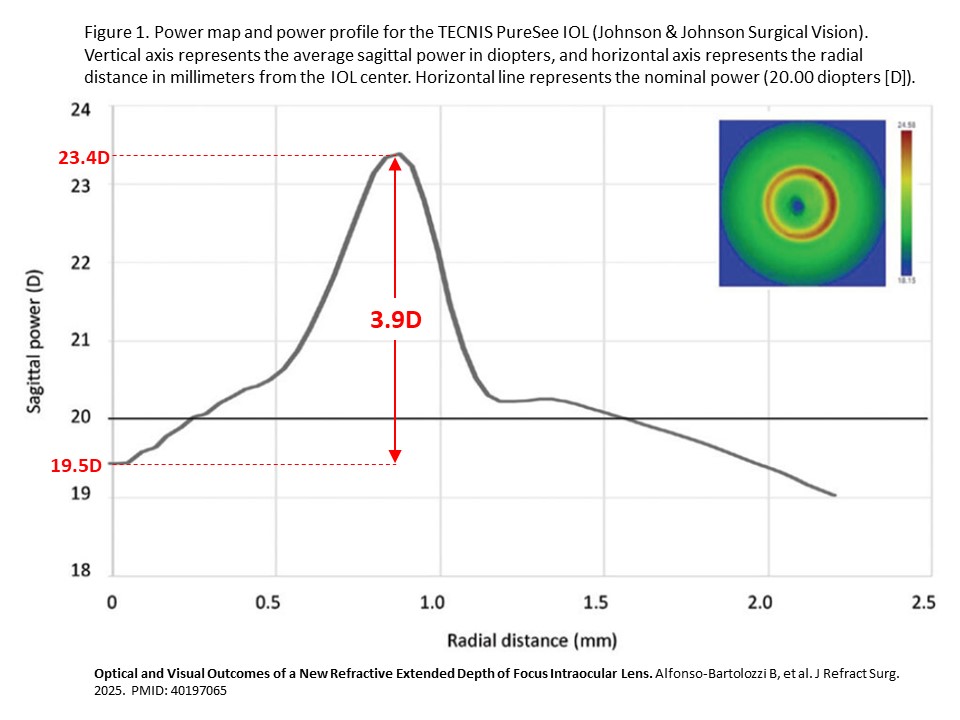
This is purely my personal view, but if it is to be sold without changing the A-constant, then, to put it in extreme terms, I even feel it might properly be sold as +19.5 D or +19.0 D rather than +20.0 D. In fact, our clinic's optimization shows that for setting PureSee's target power, reading the calculation results as the usual target power + ? D makes it easier to benefit from PureSee's characteristics, and, depending on the testing equipment, this almost always differs from the recommended first minus (theoretically, the first-minus power corresponds to about 0 D to −0.35 D).
Here we have presented a case close to a showcase case for TECNIS PureSee. We have also touched on points to note in setting the target refraction, but at present we find nothing, including papers in Japan and abroad, that specifically addresses the optimal target power for TECNIS PureSee, so for now it seems best to use powers optimized at each facility. TECNIS PureSee offers very high quality of vision, with little drop in distance vision even when shifted toward near, so it has the potential to reach its full capability with appropriate target refraction. However, because it is a refractive multifocal lens (with power varying by zone), although most people have no problems, it should also be noted that adaptation differs between individuals.
More specific, evidence-based information is likely to emerge at academic meetings and elsewhere, and we will continue to update.
2025.10.04