
This continues the case of the patient whose right eye Eyhance Toric axis was corrected.
Her right eye had high corneal astigmatism, but it was clean with-the-rule (regular) astigmatism, and the irregular component was low at 0.145 µm of higher-order aberrations (red frame in the left column of the OPD-Scan III image below), so it was an eye in which a multifocal lens could perform well as long as no postoperative refractive error or axis misalignment occurred. Next, the lens type: the eye was a long eye exceeding 26.5 mm with a steep cornea exceeding 46.5 D, so its proportions were very unfavorable, i.e., prone to refractive error. It had also originally had a TECNIS Eyhance, so for reliability we thought a multifocal lens from the TECNIS series on the same platform, namely TECNIS Odyssey, would be good, and proposed it.
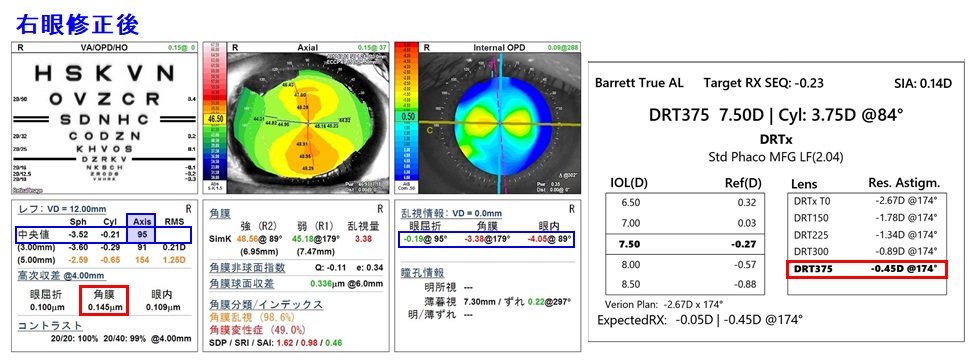
Odyssey is weaker at near than Synergy, but correspondingly has better contrast and fewer photic phenomena such as halos, glare and starbursts. However, like other diffractive multifocal lenses, Odyssey is not made in the 4.50 D cylinder power originally used; it is made only up to 3.75 D. The 4.50 D Eyhance had been a slight overcorrection, leaving slight against-the-rule astigmatism even after the axis correction, and preoperative calculations with the Barrett formula predicted that a 3.75 D toric lens would keep residual astigmatism to 0.45 D with-the-rule (red frame on the right of the figure above), so we judged this fully acceptable even with a multifocal lens. She also sometimes drives at night, so TECNIS Odyssey seemed more suitable than other companies' trifocal lenses or TECNIS Synergy. Had she wanted an imported lens, she would have had to wait another month for it to arrive, so I was worried what she would choose, but when we explained the reasons above for choosing Odyssey, it turned out she had been considering TECNIS Odyssey first herself, and the lens selection we had worried about went smoothly.
Next, power calculation. To shift from 30 cm to exact distance focus, in addition to usual power formulas we also used a special method, back-calculating from the preoperative prediction and postoperative refraction with the current lens power, but each gave a different, puzzling result, so, as usual, we prepared lenses in several powers for surgery.
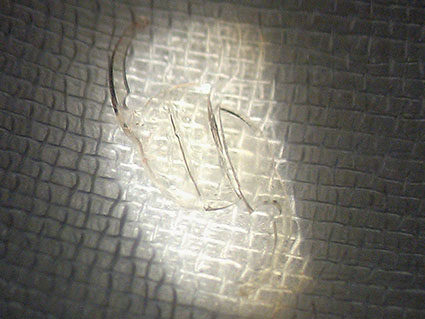
For the right eye exchange, the adhesions had already been freed once, so lens removal went smoothly. There are various removal methods; personally, I feel no stress in cutting a lens inside the eye, so to avoid unnecessary induced astigmatism and to put as little strain as possible on the wound, our clinic cuts the lens into three pieces, as shown below, and removes it through a 2.4 mm incision, the same as in ordinary cataract surgery. While at it, we also routinely polish the posterior capsule to prevent posterior capsule opacification.
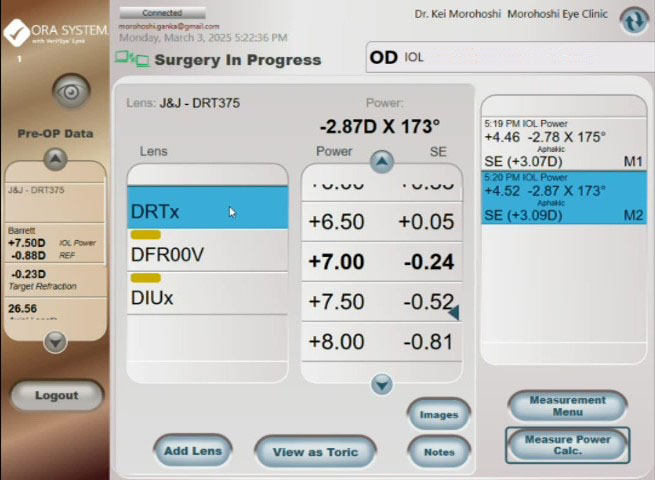
After lens removal, we performed intraoperative wavefront analysis with the ORA system to determine the astigmatic axis and lens power. As shown below, we displayed and compared three results: exchange to the same Eyhance set for distance (DIUx), to Odyssey (DRTx), and to Synergy (DFR), and then decided the final power. The left eye had an Eyhance focused at near 30 cm, securing near vision, so for this right eye we did not hold back and used a power giving clear distance vision; the surgery was completed without problems. Incidentally, the Barrett formula on the right of the figure above recommended +7.5 D, and the ORA system below recommended +7.0 D with a predicted refraction of −0.24 D, but trusting the size of the power deviation before the exchange and the results of our optimized regression formula, despite some hesitation we chose +8.0 D, for which ORA predicted a postoperative refraction of −0.81 D.
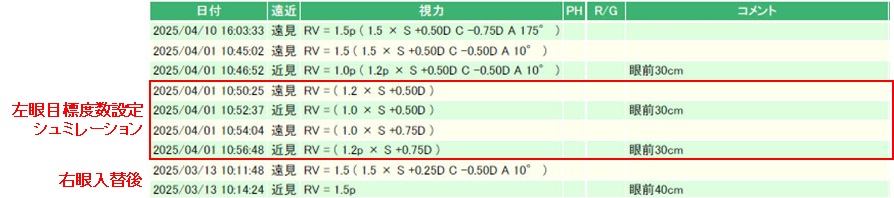
We were worried about postoperative refractive error, and also, since this was an exchange from a monofocal to a diffractive multifocal lens, about whether she would be bothered by a loss in quality of vision. But as calculated, postoperative refraction was almost zero, and from the day after surgery she had 1.5 distance / 1.0 near, good near vision for an Odyssey; she was delighted, saying things looked as sharp as with the Eyhance before the exchange. Of course, the left eye, focused at 30 cm, should see better up close, and as she was a contact lens wearer, to avoid an unnecessary exchange we had her live like this for a month first, but in the end she wished for the same exchange in the left eye.
For the focal distance of the left eye, we asked her to choose, taking the exchanged right eye as the reference, whether she wanted to see farther, about the same, or closer than the right eye. She could already see 1.0 at near, so the same target as the right eye seemed fine, but she wished for closer vision, as long as distance vision did not drop much. We therefore simulated with reading glasses, as shown below, and she wished for a power with the target set 0.50–0.75 D closer than the right eye, giving about 1.0–1.2 comfortably even at 30 cm.
Perhaps because we had told her about binocular summation and that photic phenomena increase with defocus the further the setting moves from emmetropia (zero D), just before surgery she called to change her target: "My right eye already sees well up close, so make the left the same." In the end she agreed to a setting without excessive difference between the eyes: almost the same as the right eye, but not more toward distance than the right eye.
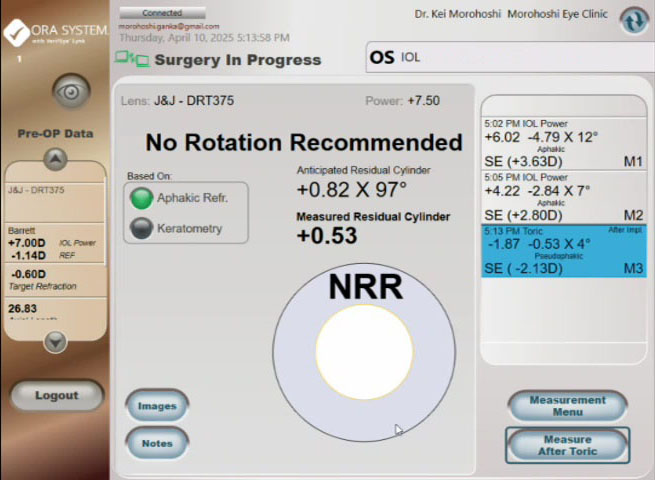
The left eye exchange came just under four months after the original surgery, so adhesion between the lens and capsular bag had progressed, but the lens was removed safely. As with the right eye, we determined the power and astigmatic axis with the ORA system, and after lens insertion confirmed that the axis was properly aligned (NRR: No Rotation Recommended), as shown below, before finishing the surgery.
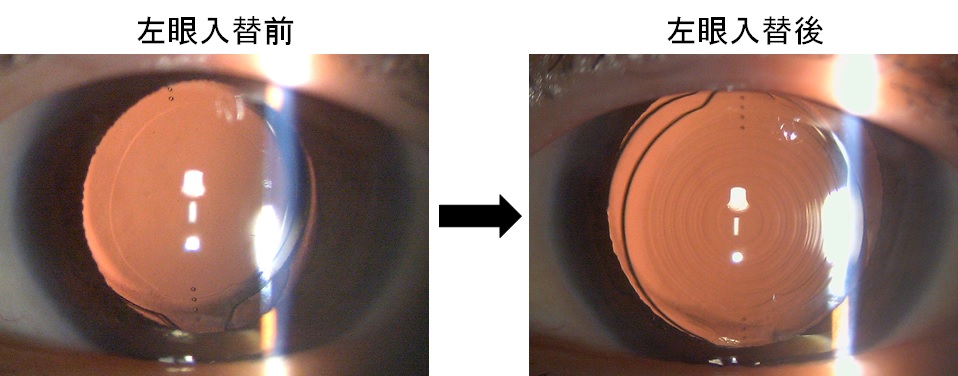
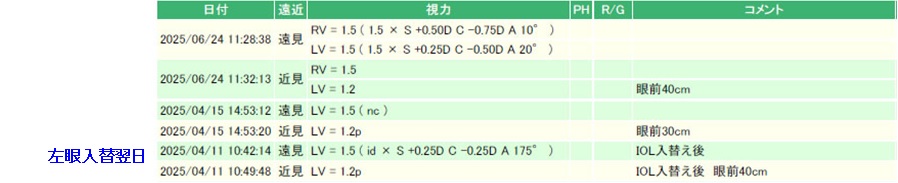
After surgery the left eye also had uncorrected vision of 1.5 distance / 1.0–1.2 near @ 40 cm, with better distance vision than in the simulation and, as simulated, good vision of 1.0–1.2 even at 30 cm; she was very satisfied.
Lens exchange must be a very stressful event for patients, mentally as well, not only the surgery itself but also the process of reaching the decision. From her first visit she had a strong will and determination to improve her situation somehow, and I too wanted to respond to her courage as fully as possible in performing the exchanges. The information provided by her previous doctor also allowed more accurate surgery, and I am very happy that in the end we achieved the result she hoped for.
Even if told not to worry about it, eye problems are hard to ignore because you see them every day, and they become problems that follow you for life. The risks of lens exchange increase with time, so if you have impaired visual function after surgery that has not improved after more than a month, we recommend consulting your doctor first, without hesitation.
Except for some lenses, I personally feel that within three months after surgery, an exchange can actually be performed more safely than a difficult cataract surgery, since no ultrasound is used. Even so, I also believe exchange should be a "last resort," only when there is no other option.
Next time, we plan to present a case one month after surgery at another clinic, when an exchange could still be performed relatively safely, in which, at the patient's request, uncorrected vision was improved by a solution other than exchange.