
In June 2021 we operated on her right eye for nuclear cataract using a toric (astigmatism-correcting) monofocal lens, and three years later she wished to have her left eye operated on.
After surgery on the right eye, she developed posterior capsule opacification about a year and a half later and had a laser posterior capsulotomy, but otherwise the course was uneventful and good. When she returned in January 2024, progression of nuclear cataract in the left eye had reduced corrected visual acuity to 0.8p, and, as shown in the right column of the OPD-Scan III image below, the moon had begun to look like three moons because of trefoil, the higher-order aberration typical of nuclear cataract, so she booked surgery.
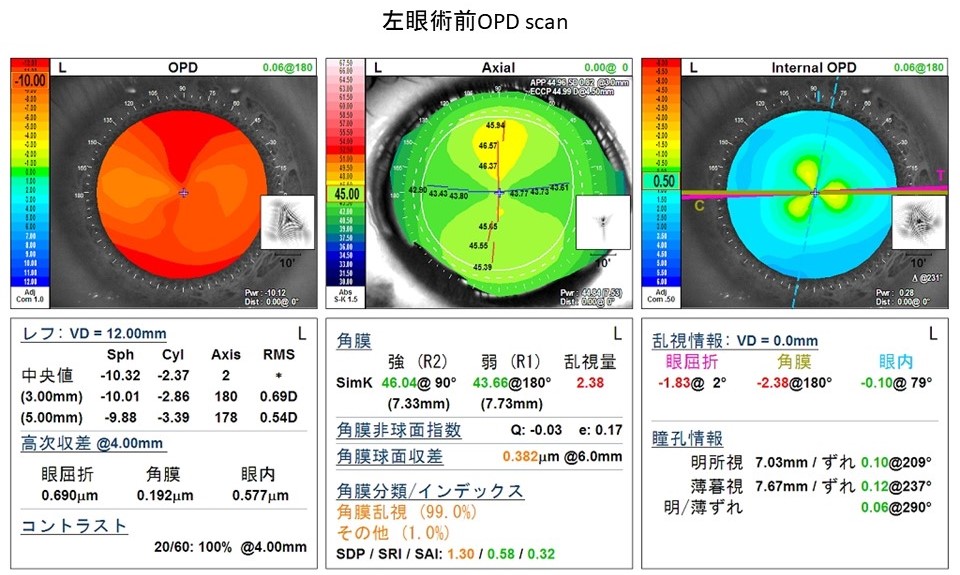
At the time of right eye surgery three years earlier (2021), she had found it hard to decide on the focal distance and on using a toric lens. Since both eyes were highly myopic and she could see up close with the left eye, we operated on the right eye with a target of about −2.0 D (about 50 cm), aiming at reading distance plus a little. Three years after surgery, subjective refraction was −1.875 D, and she was satisfied that she could see not only near but also distance better than expected (see the link below for details).
https://morohoshi-ganka.com/opeex/816
Among so-called pure monofocal lenses approved in Japan, there is almost no difference in visual function between lenses. However, back in 2021, use of TECNIS Eyhance, a higher-order aspheric monofocal lens, had already been reported abroad and was expected to become available in Japan eventually, so with future left eye surgery in mind we used in the right eye a toric monofocal lens from J&J called TECNIS Toric OptiBlue, on the same platform as Eyhance. A platform is the monofocal lens that serves as the base for multifocal and value-added lenses; in fact, J&J's other multifocal lenses such as Odyssey and Synergy, and Eyhance, all add multifocality or extended depth of focus by placing a diffraction grating or a higher-order aspheric zone in the center of the optic of TECNIS OptiBlue.
To return to the topic: as expected, by 2024, three years after surgery, TECNIS Eyhance had arrived on the Japanese market. A monofocal lens like the right eye's was of course possible, but when we also mentioned Eyhance as an option for the added value of depth of focus, this time she chose, without much hesitation, surgery with the TECNIS Eyhance Toric, a monofocal plus lens.
Next, deciding the target power. With progression of the nuclear cataract, her refraction, −8.5 D three years earlier, had become extreme myopia of about −14.0 D, so I expected her to want near focus like the right eye. However, she had been living mainly with a hard contact lens in the left eye only, in a mild monovision-like state, and had been comfortable without reading glasses. To reproduce that state, she wished for a distance target with a difference between the eyes within a range that would still allow glasses (not enough to cause anisometropia problems). Eyhance's add is only about +0.5 D, so a distance setting makes it easier to use that small added value effectively, and I also thought that choice was best if possible. Conversely, had she wanted a near target, I might have recommended the more reliable monofocal lens, since I have experienced, in one case only, an exchange to a monofocal lens because of unpleasant photic phenomena with Eyhance.
"A difference between the eyes within a range that still allows glasses" is generally said to be within ±2.0 D, but of course there are individual differences, so first we had her wear a −1.50 D contact lens in the right eye, close to the limit, to experience how it looked. The result was about 1.5 distance / 0.5 near, and she felt she did not need to see that far, so we fine-tuned again and chose the power targeting a difference of about 1.25 D between the eyes.
In left eye surgery, the nucleus was softer than in the right eye and lens removal went smoothly. We decided the lens power with reference to the total cylinder power and axis measured with the ORA system, an intraoperative wavefront aberrometer that we had not yet introduced at the time of right eye surgery.
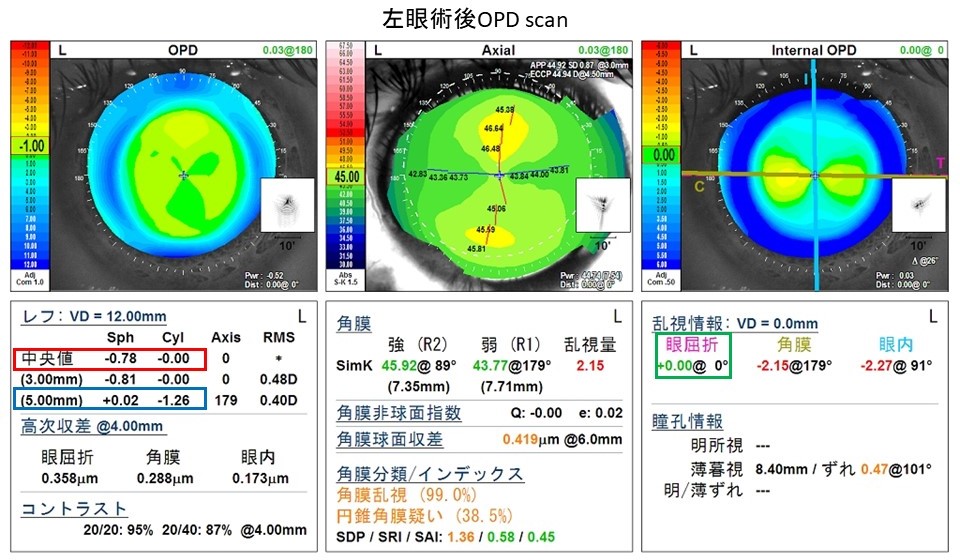
After surgery, subjective refraction was −0.25 D and uncorrected vision 1.5p distance / 0.6p near. With distance to intermediate covered by the left eye and intermediate to near by the right eye, she was pleased that she could now live without contact lenses or glasses. As an aside, the postoperative OPD-Scan III results below show from the right column that total astigmatism is zero (green frame), and from the left column that refraction at the 5.00 mm periphery (blue frame) is less myopic than at the lens center (red frame), indicating Eyhance's near add in the central zone.
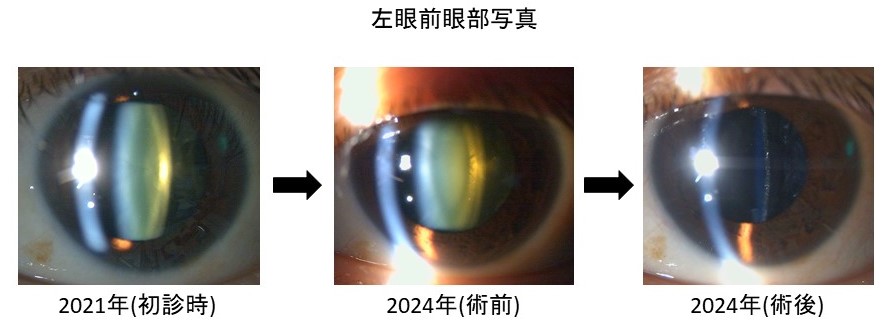
As to whether there was a cataract (lens opacity), as shown below, the left eye of course had a mild cataract from her first visit three years earlier, but corrected vision with glasses or contact lenses was good at 1.2. Our clinic does not recommend surgery unless the patient is troubled by visual impairment from cataract; we recommend surgery when the patient's own lens function has declined and the intraocular lens is expected to outperform the patient's natural lens.
To repeat what we have said before, having surgery early may mean a longer comfortable period, while postponing surgery may, as for this patient, allow use of a new, higher-performance lens; in ordinary non-urgent cataract surgery, the patient holds the right to decide the timing. So at the first visit, our clinic limits itself to assessing the current degree of visual impairment from cataract and explaining what an intraocular lens will improve and what will be lost, leaving the decision whether to have surgery to the patient, and giving them materials and time to think it over once more (Japanese). If they still wish to have surgery, they book it; of course, some book surgery on the spot at the first visit, and others take it home and decide after discussing with their family. Almost everyone who comes for consultation about cataract is in a state where surgery can improve uncorrected vision, but whether surgery is the best solution at present seems to depend on individual conditions and circumstances beyond the eye findings.
Cataract surgery is basically a once-in-a-lifetime operation, so to avoid regrets, especially for people like her who use contact lenses, or people without high myopia or hyperopia, we recommend thinking carefully about whether surgery on both eyes is necessary before booking. Of course, if you cannot decide yourself, we will advise you, so please feel free to consult us.
2024.10.09