
She is also in her 40s; this is a case of single-eye surgery in which she chose a monofocal lens.
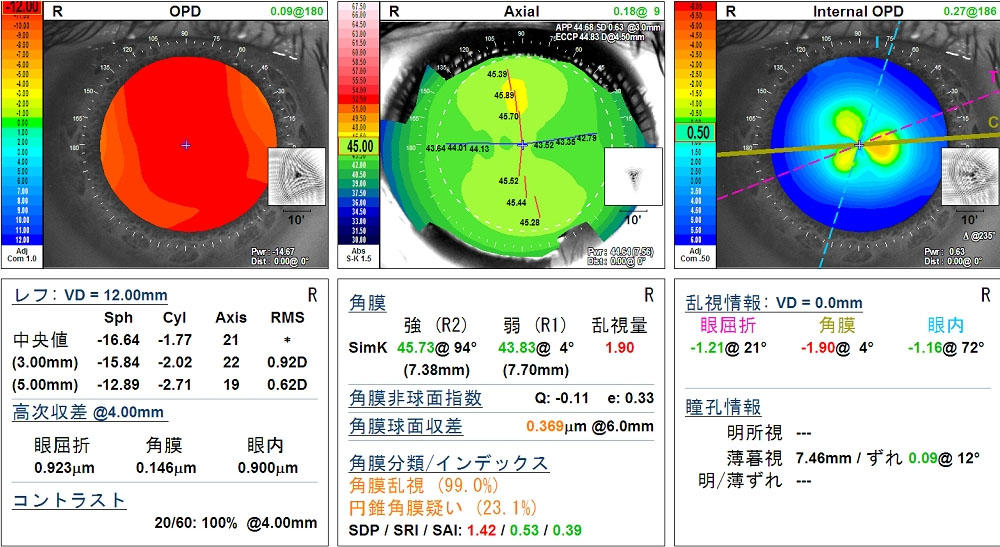
Another clinic had pointed out a cataract in her right eye about a year earlier, but her vision kept dropping and things looked triple, so she first visited us for surgical consultation and because she was worried about fundus problems from high myopia. The image at upper right of the OPD-Scan III below confirms that the cataract was the cause not only of reduced vision but of things looking triple.
As shown below, the right eye had an advanced nuclear cataract close to grade 4 in hardness, causing extreme myopia exceeding −10 D. Axial length was over 28 mm in both eyes, but there was none of the glaucoma or retinal disease she had feared.

The left eye also had high myopia of about −8.5 D and a nuclear cataract of about grade 2, but corrected vision was good at 1.2, so, also at her wish, we first operated on the right eye only. Although it was single-eye surgery, she was a hard contact lens user, relatively young for cataract surgery in her 40s, and her corneal higher-order aberrations at lower left of the OPD-Scan III above were small, so we also offered surgery with a multifocal lens as an option. However, in the preoperative questionnaire she described herself as a perfectionist with an eye for detail, and after discussion the surgery was done with a monofocal lens.
The issue in single-eye surgery for people with high myopia is where to put the focus. Her options were three: (1) distance, as with the left eye wearing a contact lens; (2) near, about −6 D, close to the left eye's uncorrected state; or (3) reading distance, 30–40 cm, about −2.5 D. The disadvantage of (1) and (3) is that the difference between the eyes after surgery prevents full correction with glasses; the disadvantage of (2) is giving up the chance to cure the high myopia. After discussing the above, she wished to reliably secure near vision while, since she was having surgery anyway, being able to live indoors with her uncorrected right eye, with a power that sees from near to, if possible, about 1 m; she chose a lens targeting −2.26 D, slightly further than (3). There was also about 1.75 D of corneal astigmatism, so the surgery was done with a toric lens to make uncorrected vision as good as possible.
The cataract was quite hard, but the nucleus was not very large, and the zonular weakness typical of highly myopic eyes was not a problem, so the surgery was completed safely.
After surgery there was none of the feared refractive error; objective refraction was −2.375 D and subjective −1.625 D, uncorrected distance vision was better than expected at 0.3–0.4, and she was delighted to be able to live indoors mostly without glasses (in people who were not highly myopic before surgery, distance vision at this refraction is often about 0.1–0.15).
When, in the preoperative explanation, we told her that toric lenses can rarely rotate after surgery and then need repositioning, she asked instead for a non-toric lens; she hesitated over each step and once postponed surgery, but in the end she was satisfied, and what struck me was how, after surgery, as if her choices had proved right, she brightened up as though a weight had been lifted.
These days there are many kinds of lenses to choose from, monofocal, insurance-covered low-add multifocal, multifocal under the elective treatment system, and self-paid multifocal, and you may well hesitate before surgery; but as with her, a monofocal lens can give a fully satisfying result (once things settle after surgery, multifocal contact lenses can also be worn), so we do recommend clarifying your own priorities before surgery.
2021.07.07
A postscript: three years after the right eye surgery, she also had surgery on her left eye.
If you are interested, please see:
https://morohoshi-ganka.com/opeex/1626