
TECNIS PureSee, a new refractive extended depth of focus lens, has been released and the number of cases is rising rapidly, but it was pointed out to us that we had not yet published a case with TECNIS Odyssey, a diffractive continuous-focus lens. With the mix-and-match with PureSee that is likely to become more common in mind, we present a TECNIS Odyssey case.
This is a somewhat special case: exchange from Eyhance Toric to Odyssey Toric in both eyes.
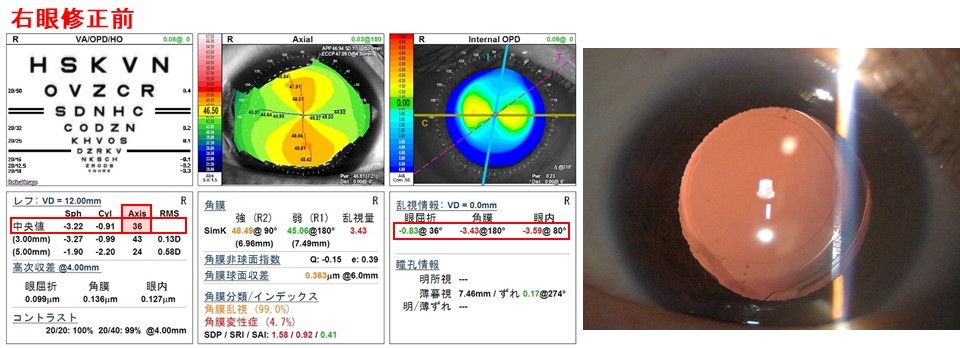
She first visited us without a referral letter in January 2025, saying, "Because of oblique astigmatism after cataract surgery at another clinic, everything looks shaky and tiring, and I want it fixed." She brought some documents, and, as shown below, the right eye indeed had oblique astigmatism of 1.25 D @ 47 degrees.

As the boxed area in the right column of the OPD-Scan III image below shows, the corneal astigmatic axis is at 180 degrees, so to cancel the astigmatism the lens must be inserted perpendicular to it, at 90 degrees. The intraocular lens axis, however, was at 80 degrees, an axis misalignment of 10 degrees. A misalignment of about 10 degrees usually reduces the astigmatism-correcting effect by about 30% (10 degrees × 3%), but vision should not become that much worse (at 30 degrees off, the correcting power is zero). In this case, however, probably because a toric lens too strong for with-the-rule corneal astigmatism had been used, overcorrection had turned with-the-rule astigmatism into oblique astigmatism, rather than leaving residual astigmatism, and this seemed to be one cause of the poor vision. For the same cylinder power, oblique astigmatism (diagonal blur) is the hardest to see with, followed by against-the-rule (horizontal blur); with with-the-rule astigmatism (vertical blur), even 0.5 D remaining is barely noticed. In other words, the least bothersome type of astigmatism had become the most troublesome.
When we talked with her, however, it turned out that she had originally chosen Eyhance expecting to be able to see as far as the cutting board when cooking. So we made it clear beforehand that even if correcting the axis reduced the blur, the focal distance would not change. We explained that if lens exchange might be needed in the future, knowing the preoperative condition would allow more accurate surgery, and that an axis correction could probably be done where she had had her surgery, and recommended that she first consult her previous doctor.
Afterwards she returned, wishing to have the axis corrected at our clinic after all, this time with a referral letter and the preoperative information below.
Calculated from the refraction values above, her refraction at the first visit was a spherical equivalent of −3.875 D in the right eye / −3.375 D in the left. Taking into account Eyhance's 0.5 D add, the calculated focal distance was 30–26 cm in the right eye / 35–30 cm in the left eye. So, as shown below, uncorrected distance vision was only about 0.1–0.2 while near vision was good at 1.0–1.2, but seeing at the distance of a cutting board without glasses was difficult.
Incidentally, when exchanging for a completely different type of lens with a completely different target refraction, having the preoperative test results allows more accurate lens power calculation and selection. This is because lens power calculation requires anterior chamber depth (the distance from the cornea to the front of the lens) and lens thickness, and results differ once the lens has been replaced by an artificial one.
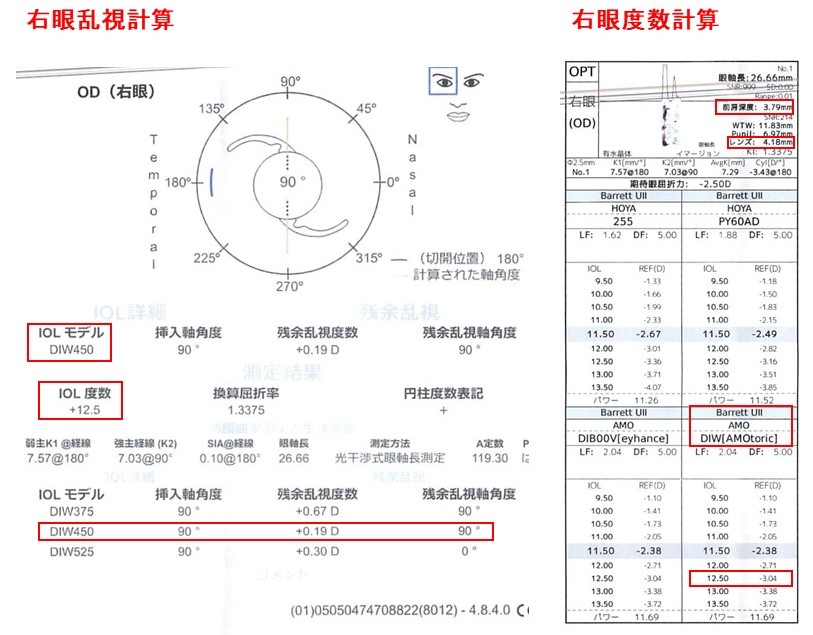
The figure above is from the documents she brought from her previous doctor. The lens used was a +12.5 D DIW450, as on the left of the figure, and the power calculation on the right shows a target refraction of −3.04 D. So a postoperative refraction of −3.875 D, allowing for the 0.5 D add, means a postoperative refractive error of only 0.335 D in the myopic direction; even if things had gone exactly as calculated, seeing the cutting board would have been difficult. I have no wish to be the "wise doctor in hindsight," but with Eyhance's 0.5 D add there is about 10 cm of extended depth of focus (range of focus) at near, so aiming for about −2.0 to −1.75 D (50–60 cm) might have satisfied her.
In other words, allowing for Eyhance's 0.5 D add, the range of clear vision was 30–26 cm in the right eye / 30–35 cm in the left, so we predicted that correcting the axis misalignment would not resolve her dissatisfaction caused by the myopic deviation. However, since she had originally come wanting the oblique astigmatism corrected, we explained that (1) it could be handled under insurance, reducing her financial burden, and (2) freeing the adhesion between the lens and capsular bag once would make any future exchange safer and secure a grace period for choosing a lens without rushing. We therefore decided first to perform astigmatic axis correction.
Axis correction can usually be performed through a side port, an incision of less than 1 mm, so it is safe and, as noted above, places little physical as well as financial burden on the patient. If the original surgery used an insurance-covered lens, including under the elective treatment system, it is customarily performed at the fee for pupilloplasty, usually about 20,000 yen with 30% co-payment.
For axis correction, since it is done through a side port as described above, calculating the fixation axis with zero induced astigmatism gave a recommended angle of 90 degrees, the same as the previous doctor's result she had brought. To be safe, we also calculated on a dedicated axis-correction website, which gave 92 degrees (see figure below), and decided to determine the fixation angle based on real-time measurements from the ORA system, an intraoperative wavefront aberrometer.
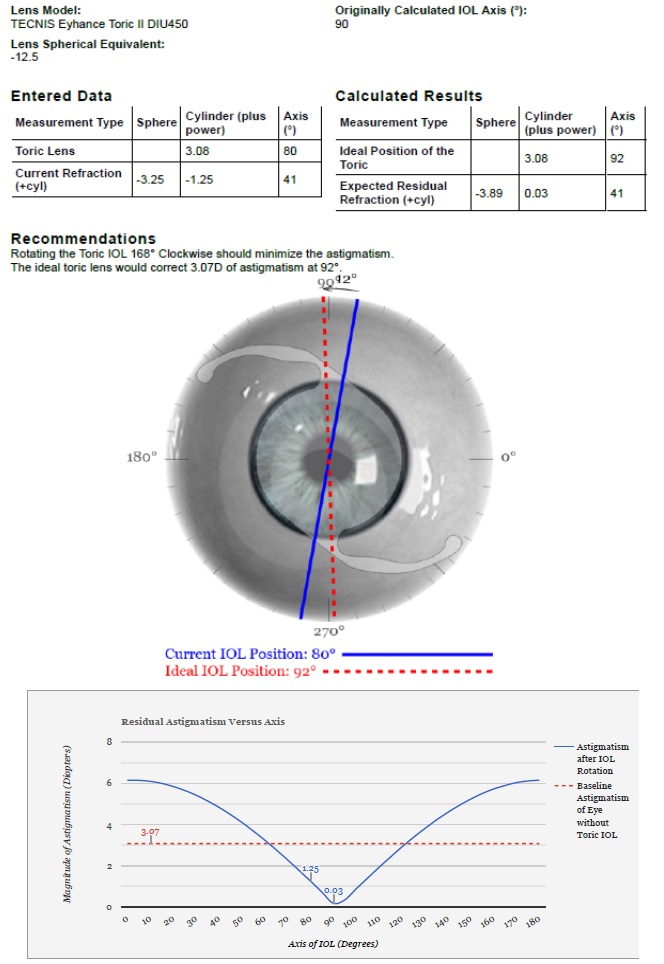
This axis correction was done one month after surgery at the previous clinic, but the appropriate time for correction is usually said to be about one week after surgery. Too early, and the lens rotates again; too late, and adhesion to the capsular bag becomes strong, with risks similar to an exchange. The hardest part of an exchange is freeing the adhesions, so in cases one month after surgery, personally, correction and exchange involve almost the same risk and stress. In this case too, the anterior capsulotomy margin had contracted somewhat, and the hinge at the base of the haptics, characteristic of TECNIS lenses, had adhered to the anterior capsule. We were able to free the adhesion without making another large incision, repeatedly measured and adjusted with the ORA system to minimize residual astigmatism, used the Purkinje images to align the lens center, and the surgery was completed safely.
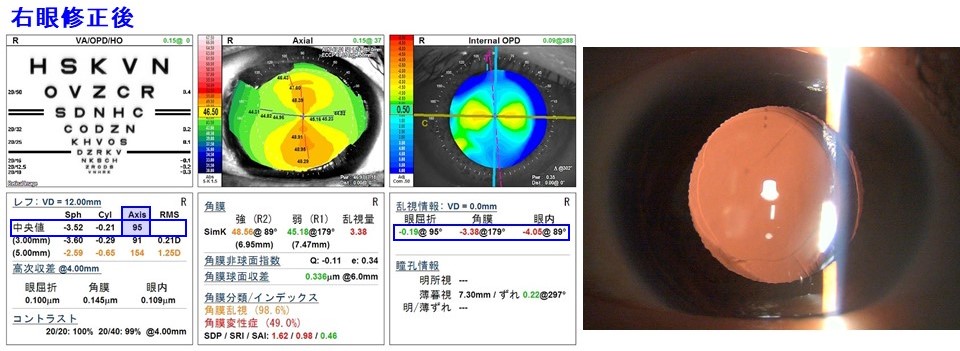
On postoperative testing, the corneal astigmatic axis at 179 degrees and the intraocular lens axis at 89 degrees (boxed area in the right column on the left of the figure above) were exactly perpendicular, 90 degrees apart. Ocular refraction (total residual astigmatism) on the OPD-Scan III was −0.19 D, and on refraction testing (below), 1.25 D of oblique astigmatism had fallen substantially to 0.25 D. Uncorrected vision improved slightly from 0.1 to 0.2, and she was pleased that, subjectively too, the shaking blur from astigmatism (monocular double vision) was gone and things looked clear.

According to the referral letter, both eyes had originally been highly myopic, about −9.50 D, so we hoped she would be satisfied for the time being now that she could see at reading distance without glasses and without blur. But distance vision was still not as good as she had expected, and she seemed to remain dissatisfied.
In any case, having once freed the adhesions, we had bought time. Since an exchange may become self-pay depending on the lens, we asked her to take at least a month without rushing, discussing with her family whether to have an exchange and, if so, which lens.
At her return visit a month later, she said that rather than exchanging the Eyhance Toric for one that would see farther, she wanted to change to a different lens altogether, a multifocal one.
To be continued
2025.08