
Lucidis, a refractive extended depth of focus multifocal lens, has recently been the subject of many inquiries. We have now operated on several eyes with it, with more than two months of follow-up, so we share our findings, including my own impressions of using it.
The first Lucidis case in Japan was a 48-year-old man with an atopic cataract in one eye.
He had noticed blurred vision in his left eye for about three years, and with presbyopia he also found his smartphone hard to see and used Hazuki magnifying glasses for the computer. He first visited us without a referral letter in May 2024, wanting to discuss whether it was fine to keep waiting.
He was being treated for atopic dermatitis and had been told of a cataract by his previous doctor. Only the left eye had a typical atopic cataract with anterior capsule fibrosis extending into the pupillary area, but corrected visual acuity was about 0.9 at both distance and near, so he still seemed to see relatively well and retained some accommodation, and we recommended observation for the time being. Ordinary age-related cataracts progress slowly over six months to a year, but atopic and traumatic cataracts sometimes progress rapidly month by month, and the appropriate, safe timing for surgery can be missed. We therefore recommended a visit in one month if he noticed a rapid drop in vision, or in three months if not, so that we could first understand how fast it was progressing.
The second visit was three months later. As expected, the cataract had progressed somewhat and corrected visual acuity had fallen to 0.8p, but the area of anterior capsule fibrosis had not grown much and surgical risk had not increased, so we prescribed reading glasses and continued observation, asking him to return in 1.5 months.
At the third visit in December, corrected visual acuity had fallen to 0.6 and he wished to have surgery, so, since imported lenses were among the candidates, he booked surgery for February. At his age some accommodation still remained, so depending on the lens choice, either distance or near vision might be sacrificed. His preoperative questionnaire answers, "I don't mind wearing glasses; I want to see sharply" but "I want multifocal lenses," "near matters more than distance," and "I sometimes drive at night," made it quite difficult to choose a lens that met all his wishes.
Driving is his hobby, and at work he reads large volumes of documents on a computer every day; as long as he could see the computer screen, he wanted to prioritize high quality of vision, free of photic phenomena such as halos and glare, over near vision. Initially he said he was vaguely considering Vivity, or, if he was a candidate, Lucidis, which our clinic had just begun to adopt.
Lucidis is not a newly developed lens like the PanOptix Pro discussed below; it has been used for many years, mainly in Europe, and is a lens with a proven, reliable track record (details of Lucidis here, Japanese). It has been used in many patients in Europe and other countries, with many reports on its safety and high satisfaction with quality of vision, but there was no experience of its use in Japan, let alone my own, so I could not explain the lens from experience. We therefore explained, as follows, the differences in specifications and the differences in quality predicted from structural differences, and in the end let him choose.
Among the differences between Vivity and Lucidis, the most important seems to be (1) the near add: Vivity is +1.5–2.0 D, about 50–60 cm, whereas Lucidis is about +2.5 D, about 40 cm, giving a near focal distance almost the same as the trifocal PanOptix. Next, (2) the size of the near add zone: Vivity has a central 2.2 mm diameter, whereas Lucidis is smaller at 1.0 mm, so the risk of photic phenomena may be lower with Lucidis. As for (3) light energy loss, which affects contrast, we have been told by SAV that Vivity is almost the same as a monofocal lens (0–1%?), and Lucidis is also almost the same as a monofocal lens at 1–3% (about 5–10% for the adult natural lens). Finally, also important: (4) Vivity is covered by the elective treatment system, so the surgical fee is covered by insurance, whereas Lucidis is fully self-pay, so the surgical fee is also self-pay, not just the lens.
Understanding the above, he finally judged that Lucidis was more likely to meet his wishes and chose Lucidis.
Since this was a lens I would be using for the first time, what I could do to avoid any disadvantage to the patient was, besides reproducible technique of course, to set a target refraction that would draw out 100% of the lens's characteristics and research carefully to bring refractive error close to zero.
I have been fortunate to have opportunities to use several new lenses, and I believe the biggest problems at those times are setting the target refraction and postoperative refractive error. Even on the same platform (base monofocal lens), the optimal target refraction changes with the optic design. TECNIS Synergy and TECNIS Odyssey are prime examples. Conversely, if the target refraction is set appropriately and surgery is performed without postoperative refractive error, the chance of obtaining at least results matching the lens specifications rises greatly. His unoperated right eye had reduced uncorrected near vision of about 0.5p due to presbyopia but good distance vision of 1.5, so after discussion he agreed that the target for the left eye would be the same as the right eye or slightly near-dominant, and that, in the end, based on intraoperative measurement with the ORA system, we would choose a power at least not more toward distance than the right eye.
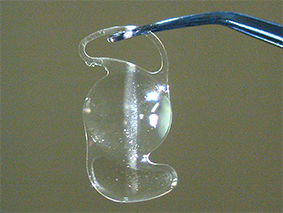
For the surgery, to be safe, we prepared two backup lenses of different powers. We did not notice much of the zonular weakness typical of atopic cataract; the anterior capsulotomy and lens removal went without problems, and we performed intraoperative wavefront aberrometry with the ORA system, which recommended a power completely different from those prepared (-_-;). With new lenses, the constants used in the ORA system are not yet optimized, and we had often encountered this situation, so while referring to ORA's recommendation, we chose the power from among the results of several prediction formulas run before surgery. The lens has distinctive, large, or rather bulky, haptics, which take a little extra effort to insert but can be expected to give good stability in the capsular bag; considering long-term stability, we also inserted a capsular tension ring (CTR), and the surgery was completed without any special events.
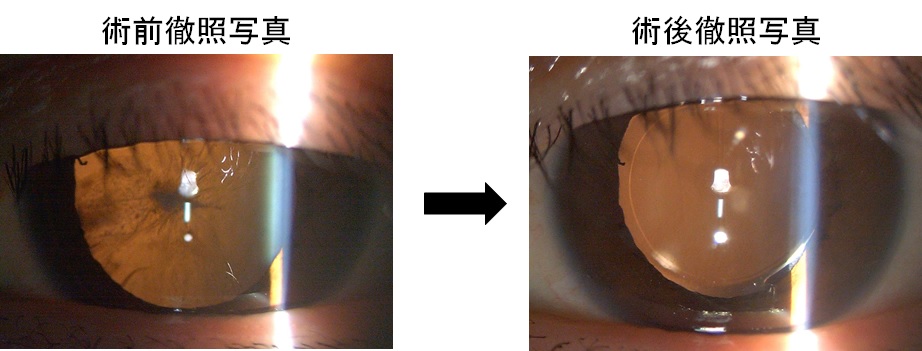
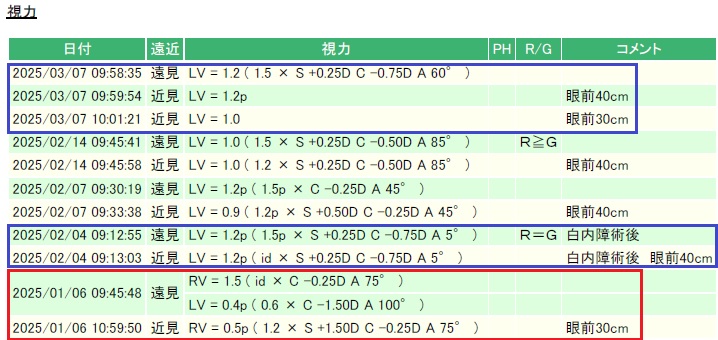
The figure below shows the change in vision before and after surgery. On the day after surgery (2/4), uncorrected vision was 1.2p distance / 1.2p near, with quick recovery at both distances, and at one month it was 1.2 distance / 1.2p near at 40 cm / 1.0 near at 30 cm. He said he noticed no photic phenomena such as halos and glare at night, which he had been worried about, and he was very satisfied, saying it was as if he had gone back to before the cataract and presbyopia.
In the postoperative retroillumination photo above alone, since it is not diffractive, no diffraction grating of concentric rings is visible, and it looks no different from an ordinary monofocal lens. By cleverly using the microscope's light reflex, however, we could just make out the central add zone, as shown below. Can you see it? That the add zone is hard to distinguish even under the microscope also suggests the high quality of vision.
Lucidis add zone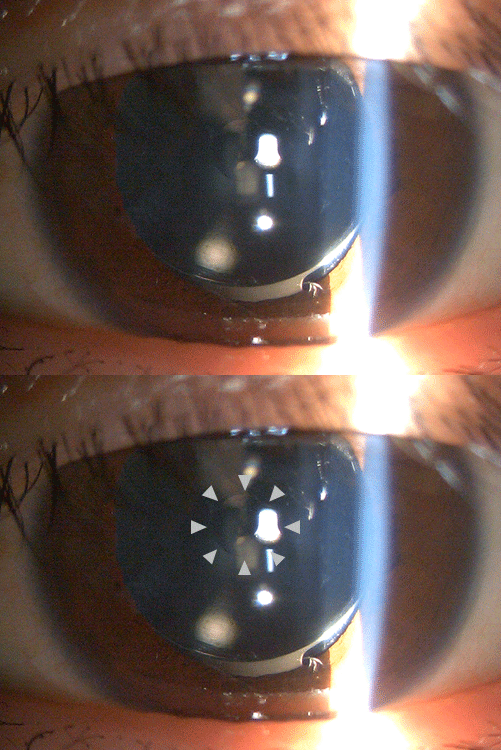
So far we have described the strengths of Lucidis; from here I describe points to watch that I have noticed in using it.
The small central add zone of 1.0 mm seems to be a plus for avoiding the risk of photic phenomena such as halos and glare and for improving quality of vision. Having used it in several cases, however, I feel that this small add zone is somewhat of a minus for stable near vision. The add power is the same, about 2.5 D, for Lucidis and for the MiniWELL, which is similar in specifications and structure, but my impression from patients after surgery is that near vision is smoother with the MiniWELL, whose zone responsible for near vision is larger at 3.0 mm; apart from its one weakness, the MiniWELL can be said to be a lens with a wide strike zone. In numbers, this patient had very good uncorrected vision at 30 cm of 1.0, but we have also had a Lucidis case in which near vision took time to come up, which we will publish another time. Thus, for multifocal lenses with a central add zone, including Vivity, not only the add power but naturally also the size (area) of the add zone seems to affect near vision. In that respect, I think the MiniWELL, with the same add power but a larger add zone area, can make more effective use of its near zone than Lucidis. As a similar example with a different structure, LENTIS Mplus X allows better near vision by slightly enlarging the add zone of the usual LENTIS Mplus.
Another point to watch is that Lucidis comes in two sizes, 10.8 mm and 12.4 mm. Different lens sizes mean a different effective lens position (ELP, discussed below), so power prediction must be optimized for each size. Our clinic has already used several of each size, and the tendencies of their errors differed greatly, so understanding those tendencies will be our next task in bringing Lucidis refractive error close to zero.
When using a lens for the first time, to avoid disadvantage to patients as much as possible, I use it in eyes with standard axial length and corneal power, where refractive error is less likely. This patient happened to have standard proportions, and at his request we used Lucidis and achieved the result he hoped for, to my relief. We have also used Lucidis with good results in highly myopic eyes and in eyes with strong astigmatism, which we will present another time.
Thus, to achieve results matching the lens specifications, bringing refractive error close to zero is at least essential. For example, patients see far better if a beginner takes 30 minutes to operate with exactly the right lens than if a senior surgeon operates in 5 minutes and leaves a refractive error, and since multifocal lenses are more affected by such errors than monofocal lenses, more precise surgery is required. To repeat what I have said before: with advances in surgeons' skills and equipment, cataract surgery has become a highly refined procedure, and these days I feel that postoperative refractive error is about the only thing that differentiates surgeons; our clinic places emphasis on this in our surgery.
While on the subject of refractive error, a point to note about the ORA system, an intraoperative wavefront aberrometer. Occasionally, when we explain surgery, patients ask, "Will you use ORA in my surgery?" As long as the surgical situation permits (if the patient can fixate during surgery), our clinic uses the ORA system in almost every case. Some people have the misinformation, probably from the internet (YouTube?), that "ORA can measure where the lens will sit, so there is less error, right?" Please note that it cannot measure the predicted postoperative lens position (ELP). When we were given the opportunity two years ago to meet ORA system engineers at ALCON headquarters in the US, I asked directly, and was told that ORA's power decision predicts lens power using four parameters: axial length, corneal power, WTW (corneal diameter), and the total ocular aberration value measured during surgery. Surprisingly, lens thickness and anterior chamber depth, which seem likely to strongly affect ELP, were not among the factors determining lens power. If ELP could be measured before or during surgery, more accurate power prediction could be expected, but that is not possible at present. I still use the ORA system because, as long as the power decision is a "prediction," using the same measurement methods and parameters as before, such as axial length and corneal power, leads to the same tendencies of error and limits prediction. By predicting from multiple angles, combining results from a completely different method, using the total aberration value obtained during surgery, I want to improve accuracy and, to avoid disadvantage to patients, avoid even slightly the unexpected refractive error known as a refractive surprise, which is considered unavoidable. In any case, at our clinic the doctor makes the final decision on lens power, and to avoid misjudging it, we continue daily to analyze feedback from patients and to research.
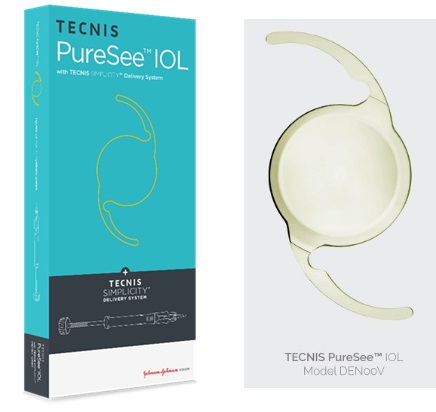
As for "refractive extended depth of focus lenses with an aspheric zone (near add zone) in the center of the lens" like Lucidis, J&J's TECNIS PureSee, which has a similar structure as we mentioned before, will soon be available in Japan. And for ALCON's Clareon Vivity, for which we have handled astigmatism with LRI (limbal relaxing incisions), Clareon Vivity Toric (toric Vivity) is expected to become available from next month, May. (Incidentally, being able to measure astigmatism in real time, so that residual astigmatism can be brought as close to zero as possible, has greatly improved the precision of astigmatism correction by LRI, another major advantage of using the ORA system.) Although the optic designs of these two lenses differ, both are extended depth of focus lenses with a central add zone, and their specified near add appears almost the same, so we expect patients will find the choice very difficult. If you are considering them, please consult us; we will match the lens to your needs and the lenses' characteristics, and once we have had the chance to use and compare them, we will give advice based on that experience.
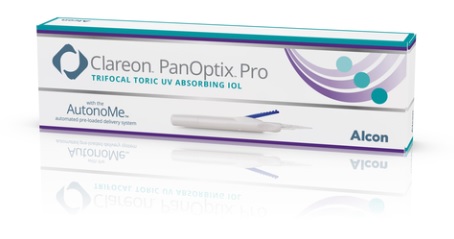
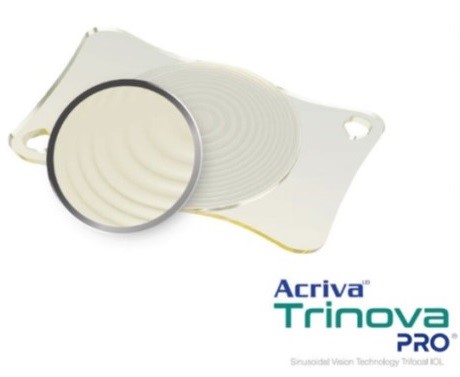
Among diffractive multifocal lenses, ALCON will soon launch in the US the PanOptix Pro, which may literally be an upgraded successor to PanOptix. Its near focal distance remains 40 cm, but it uses light energy more effectively (loss of 6% for Pro versus 12% for PanOptix) and appears to raise vision around 1 m, which dips somewhat with every diffractive multifocal lens. Looking only at these specifications, they seem to me almost the same as INTENSITY, which claims to be a diffractive penta-focal lens. However, compared with Intensity, whose diffraction grating covers the whole surface, if the PanOptix Pro keeps it within the central 4.5 mm like PanOptix, I expect photic phenomena such as halos and glare to be fewer with the PanOptix Pro than with Intensity. Just recently, we had a case in which a patient who had undergone same-day bilateral surgery with Intensity at another clinic had trouble at work due to hazy postoperative vision (waxy vision), and at their request we exchanged it for MiniWELL; we will share this too when we have the chance. In addition, Acriva Trinova Pro, which slightly strengthens the near vision of VSY's Acriva Trinova, a diffractive trifocal lens with a sinusoidal pattern, will be added to the lenses covered by the elective treatment system (a case with the standard, non-Pro Acriva Trinova is here). Diffractive lenses are advancing steadily in this way, but personally I would love to see a lens like ALCON's former ActiveFocus, which devoted the lens center 100% to distance rather than near, made again with today's diffractive technology.
This is our first update to the case collection in six months, so the content has ranged widely, covering Lucidis, postoperative refractive error, the ORA system and new multifocal lenses to be released, and I apologize for the information overload. More lens options may be welcome, but it is also a fact that making the right choice is becoming ever more difficult. As I repeat every time, no perfect multifocal lens equivalent to the natural lens exists. Without being swayed by novelty or trends, and with the intention of leaving the specific lens choice (matching) to a specialist, I believe the most important thing for postoperative satisfaction is first to clarify your own priorities before surgery, so I recommend that those considering surgery organize and confirm them once more.
2025.04.16