
She first visited us in January 2024 for consultation about a multifocal add-on lens.
She had no referral letter but brought test results from her previous doctor and detailed documents she had prepared herself. Originally highly myopic in both eyes, she had visited a hospital in the Kansai region wanting ICL, but because only her right eye was unsuitable for ICL, she was advised to have cataract surgery with a multifocal lens instead, and surgery was performed with TECNIS Synergy. After surgery, however, she felt that "I can sort of see far and near, but everything seems blurry overall," so-called waxy vision, and in May 2023, two months after surgery, the lens was exchanged for a monofocal lens set for distance. But then she could no longer see up close, and the difference between her eyes felt unpleasant, so she was considering a multifocal add-on lens.
We do not know what the cataract in her right eye was like before surgery, but according to the test results she brought, corrected visual acuity was 1.2, and since ICL had been considered, it seems there was at least no significant cataract. In other words, cataract surgery for the purpose of refractive correction, so-called Refractive Lens Exchange (RLE)/Clear Lens Exchange, had been performed, so the loss of quality from photic phenomena and reduced contrast with the diffractive Synergy came to the fore, and the deterioration in vision may have become bothersome. This shows clearly that, unless there is a compelling medical reason, cataract surgery should not be performed casually when there is no visual impairment.
The left eye had extreme myopia of about −16.5 D and wore a contact lens (CL); with the CL it had good distance and near vision, so ample accommodation still remained.
At her first visit to us, the right eye's refraction was mildly hyperopic at +0.625 D, but the exchange to a toric monofocal lens had been done cleanly, with almost zero residual astigmatism. Orientation is critical for toric lenses, so they are harder to use in exchanges where the anterior and posterior capsules have adhered, but it was exactly on axis, suggesting surgery at a highly skilled facility. However, since it was a monofocal lens, uncorrected distance vision was good at 1.2p, but near vision was, naturally, 0.1.
Given this course, a multifocal add-on lens did seem a reasonable choice. She had already had one exchange from a diffractive multifocal to a monofocal lens, and even with an exchange to a non-diffractive multifocal lens, there was concern about the risk of a third operation back to a monofocal lens because of photic phenomena or ghosting, so we proceeded with surgery using a multifocal add-on lens, which can easily be removed if she is not satisfied. Of course, we also confirmed that she met the other conditions, such as sufficient anterior chamber depth and corneal endothelial cell density and no excessive angle pigmentation.
Our clinic had used multifocal add-on lenses before, but only "diffractive" ones with ring structures like TECNIS Synergy, so I felt it would be quite hard to satisfy her with existing multifocal add-on lenses. After discussion with her, we decided this time to use the add-on version of EVOLVE, an extended depth of focus (EDOF-type) multifocal lens from SOLEKO of Italy.
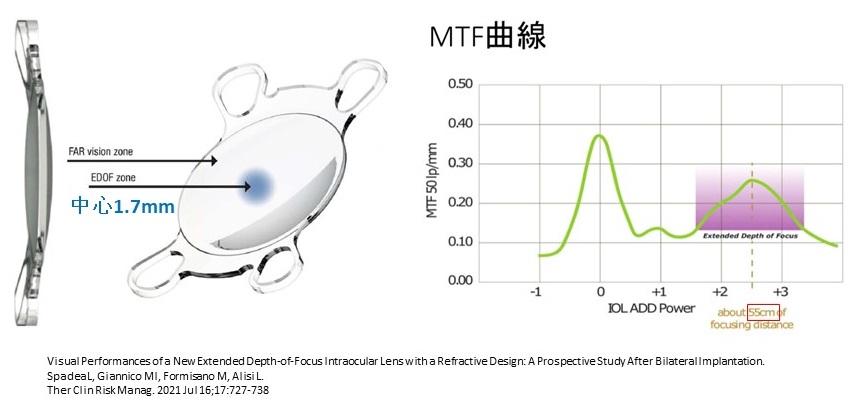
EVOLVE has a central add zone like TECNIS Eyhance, Clareon Vivity and the MiniWELL, but because of its refractive + EDOF design there is almost no loss of contrast and almost no photic phenomena (lower left of the figure below; the add-on lens differs from the figure in haptic design). Being an EDOF type, however, its near add is somewhat weak, about 2.0 D = 50 cm (2.5 D at the lens plane), placing it roughly between Vivity and the MiniWELL; with about 40% of light energy allocated to near and intermediate, it is reported to provide vision to about 45–50 cm in practice (lower right of the figure below). The size of the add zone, 1.7 mm, slightly smaller than Eyhance's, may be what makes quality of vision equivalent to a monofocal lens possible. This is purely my personal view, but you might picture it as a stronger-add version of Eyhance.
As shown below, after the exchange her spherical equivalent refraction was +0.625 D, slightly hyperopic, so the add-on lens would naturally also correct that hyperopia, besides adding multifocality. To make up for the weak near add of the EDOF lens, we carefully simulated in preoperative testing how far toward near the target could be shifted without reducing distance vision, and decided the power of the add-on lens.
As a result, as shown below, shifting 0.75 D toward myopia (adding +0.75 D glasses) did not reduce distance vision, which remained good at 1.5, while +1.0 D reduced it slightly to 1.0–1.2. We similarly simulated near vision at several powers and had her compare with the unoperated left eye, which showed that a +0.75 D shift toward near was best. All that remained was to calculate the add-on lens power corresponding to that shift and order it, but lenses are made only in 0.5 D steps, and no lens shifts exactly 0.75 D. After discussion, we explained three points: (1) her right eye was now used to high-quality monofocal distance vision, so shifting too far toward near might feel unsatisfying; (2) the further toward near, the greater the light spreading from defocus; and (3) she could see up close with the unoperated left eye wearing a CL. She agreed to surgery with a lens power slightly more toward distance than 0.75 D.

The surgery itself causes the surgeon little stress, i.e., it is highly safe, and it was completed without problems. On the day after surgery, she had good uncorrected vision of 1.5p distance / 1.2 near and was delighted with clear vision like a monofocal lens and seeing up close better than expected. After that, as shown above, refraction fluctuated slightly, but it stabilized almost exactly on the mild myopic target: day after surgery −0.375 D → one month −0.50 D. However, at the one-month check-up on 5/31, she said, "I feel distance has become a little harder to see." According to the results above, spherical equivalent had shifted slightly toward distance, to −0.50 D from −0.625 D on 5/7, so normally distance should have become clearer and near weaker; her perceived ease of seeing did not match the refraction. This phenomenon is sometimes seen after surgery with lenses whose power varies by zone of the optic, especially those with a central add or sector-type multifocal lenses. The machine-measured refraction also includes the add zone and so reads somewhat more myopic than the reality, and it often diverges from subjective refraction. In other words, it may be a perceptual change depending on habits such as which part of the lens one uses to look at things, and it may improve to some extent with adjustments such as weakening the left eye's CL power slightly so that she looks at distance with the add-on right eye. Another possible cause of the difficulty was posterior capsule opacification, so we are observing her, planning laser treatment if corrected vision also falls.
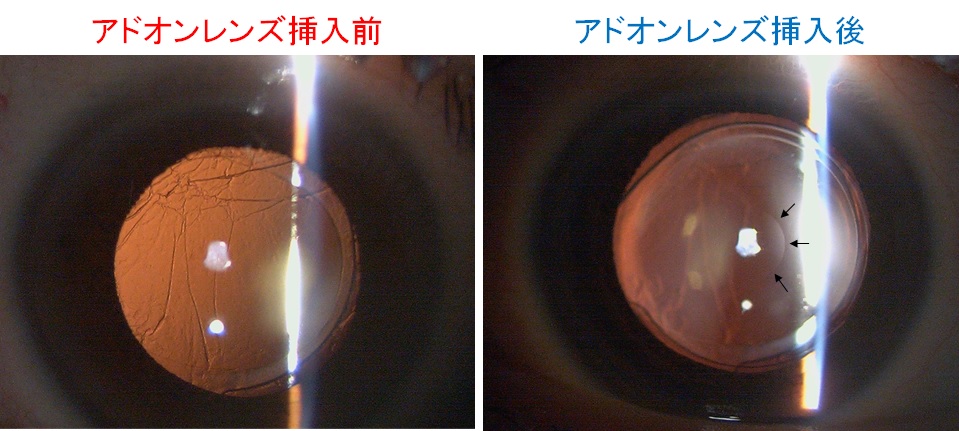
This was also our clinic's first case with the add-on lens version of the refractive + EDOF EVOLVE. Although its near add is weak, it provides high-quality visual function that compares well with a monofocal lens, so with appropriate candidacy and power selection it seems usable as a very valuable add-on lens. Even under the microscope (slit lamp) at examinations, it is indistinguishable at a glance from a monofocal lens, and, as on the right of the figure above, the edge of the near add zone (black arrow) can only be made out by searching hard using light reflections (the other lines are folds in the posterior capsule).
This was not a cataract surgery case, but it is a valuable case in which the patient compared TECNIS Synergy → a monofocal lens → EVOLVE in the same eye, so we have published it as information. Having three operations in total must have been very hard for her, but I am glad as her surgeon that she was ultimately satisfied, and the case allowed us to verify the high-quality vision of EVOLVE, no worse than a monofocal lens.
In terms of multifocal function, intraocular lenses used in ordinary cataract surgery are clearly more advanced than add-on lenses, but a strength of EVOLVE seems to be that an add-on lens with the same design as the intraocular lens can be used.
I myself do not know whether a multifocal add-on lens was the best answer for her, but the result was good enough to make me think that, as a multifocal add-on lens for people who already have a monofocal lens set for distance, our clinic will now choose EVOLVE exclusively. However, when using it in people with a monofocal lens set for near, care is needed in setting targets, and trifocal add-on lenses with a proper add from Rayner or 1stQ may also need to be considered.
EVOLVE for ordinary cataract surgery (not the add-on version) is available in a wide range of powers and can also be used for people with high myopia or astigmatism who would be outside the range of usual lenses. It is fully self-pay, not covered by insurance, but if you are interested, please feel free to consult us.
2024.06.23