
A nearby clinic had pointed out cataracts about three years earlier, and he first visited us because he was considering surgery and wanted to hear about lenses.
Both eyes were long, over 28.5 mm (high myopia), and the right eye had become even more myopic due to an advanced nuclear cataract, reaching extreme myopia of about −15.0 D, so with his own glasses he saw only 0.06p. He wished for multifocal intraocular lenses if possible, so after matching each lens's features against his wishes, the surgery was done with Synergy.
People with high myopia can usually accept distance glasses but often want to see near without glasses; he, however, said that if anything he did not mind near glasses but wanted to see clearly at distance, so for the more advanced right eye first, we chose the power to match distance exactly, without holding back.
He was taking a prostate medication (an alpha blocker) and his pupil dilated somewhat poorly, but there was little IFIS (intraoperative floppy iris syndrome), and the surgery was completed without problems.
From the day after surgery he had very good vision of 1.5 distance / 1.2 near uncorrected; he wished for the same target refraction in the left eye, and, as with the right eye, was very satisfied with postoperative vision of 1.5 / 1.5 uncorrected for distance and near. Vision at 30 cm was also good at 0.8, and, perhaps because we matched refraction to zero, he said the feared halos, glare and starbursts when driving at night did not bother him much.
Right eye preoperative slit-lamp photo Preoperative retroillumination photo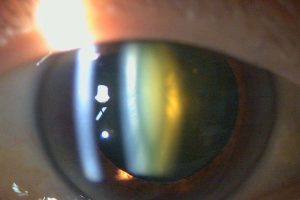
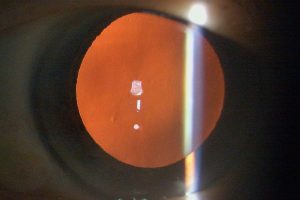
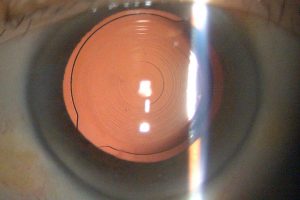
Right eye postoperative slit-lamp photo Postoperative retroillumination photo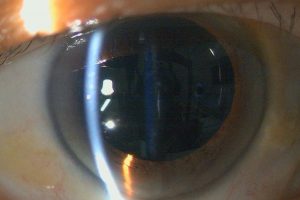
In addition to the postoperative survey, he told us: "The doctor explains in detail while operating, but hearing 'Next I'm going to do such-and-such!' actually made me brace myself and become more tense. Some people probably want explanations, but in my case there were things I'd rather not have known." I usually narrate as I operate, saying things like "I'm opening a circle in the surface of the cataract," "I'm breaking up the cataract with ultrasound," "I'm inserting the lens," but indeed some people would prefer the surgery to be over before they know it, so since this case we ask about this during the preoperative explanation. Cataract surgery is done under local anesthesia, so I believe that when surgeon and patient cooperate, the surgery can be less stressful. Please feel free to tell us any questions or requests without hesitation.
2021.09.23