
We received a request for a case of multifocal lenses in a patient with glaucoma, so we present one here.
She had noticed reduced vision in her left eye for a year and had been considering cataract surgery with multifocal lenses, but because she was also using glaucoma eye drops, she could not reach a decision she was comfortable with, and she first visited us with a referral letter from another clinic. Counting her regular doctor, ours was the fourth eye clinic she had visited.
As she had noticed, the left eye had an advanced unilateral nuclear cataract typical of high myopia, with refraction of −18.0 D; she had always worn contact lenses, and from her first visit wished for surgery with multifocal lenses if possible. When we asked her priorities for postoperative vision, her rather difficult, surgeon-taxing wish was: "Near vision matters most, for things like sewing-machine work, but I also drive, so I want to see far too!"
She wanted to choose a lens regardless of whether it was covered by the elective treatment system, but her previous doctor had prescribed one mild glaucoma eye drop for suspected glaucoma, so we decided to judge candidacy from visual field results, and at the first visit gave her the surgical information to consider. Note that candidacy for multifocal lenses and which lenses might suit someone can be assessed to some extent even at the first visit, but to shorten patients' waiting time, detailed explanations of surgery and lenses are in principle given after the decision to have surgery at our clinic; thank you for your understanding.
To assess suitability for multifocal lenses, since depending on glaucoma severity multifocal lenses may have to be ruled out, we first did a visual field test; compared with her previous doctor's results there was no advanced glaucomatous field loss, and the main finding was an overall reduction in sensitivity probably due to cataract. As the next step, we had her stop wearing hard contact lenses for a week and performed corneal topography: there was mild with-the-rule astigmatism but a clean cornea with almost no higher-order aberrations (see OPD-Scan III below), so we judged her to be "a candidate for multifocal lenses."
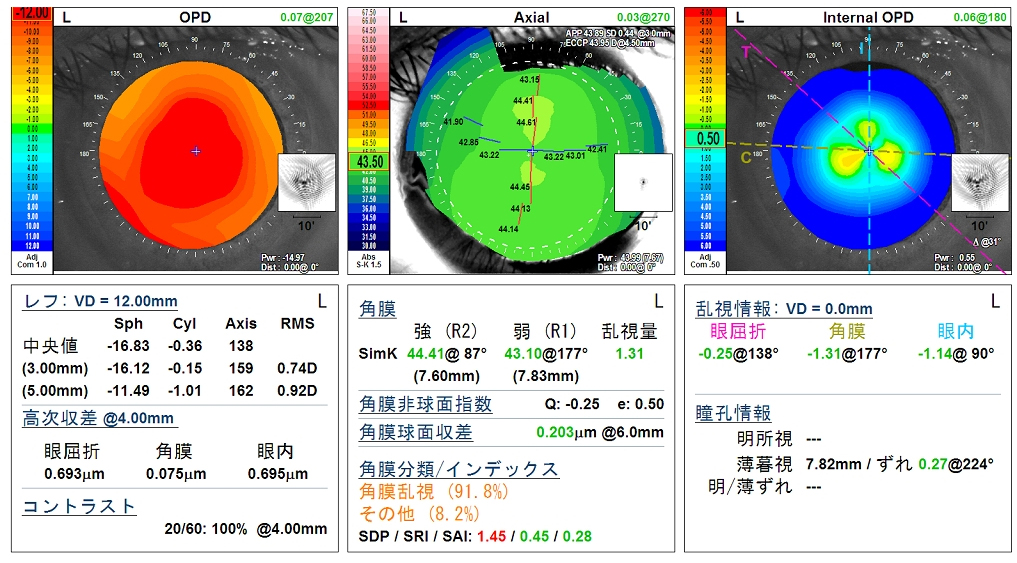
As for the choice of lens type, in the end she weighed MiniWELL Ready if driving was the priority against TECNIS Synergy if near was the priority, and, giving priority to the focal distance she would probably spend the most time looking at in daily life, chose TECNIS Synergy. Since her wish from the start was "near matters most, but I want to see far too!", we chose the power aiming for exactly zero refraction and astigmatism, to secure distance vision firmly and minimize halos and glare when driving at night, and the surgery was done with the toric TECNIS Synergy.
The pupil dilated somewhat poorly, but the surgery was completed without problems; after surgery, as targeted, refraction was zero and astigmatism zero, and her vision, 0.02 uncorrected distance / 0.5p corrected near before surgery, became 1.5 distance / 1.2 near uncorrected, very good vision with which she was very satisfied. The day after surgery her husband, an ER doctor at a university hospital, came to greet me, and his presence made me feel for a moment as if I were a resident again (sweat). Perhaps meeting me only after the surgery was his thoughtful way, as a doctor himself, of not putting extra pressure on the surgeon beforehand. I take this opportunity to thank him for his consideration.
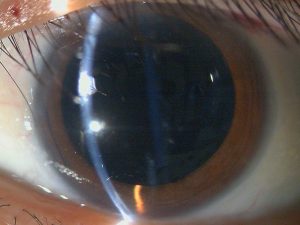
<Preoperative slit-lamp photo> <Postoperative slit-lamp photo>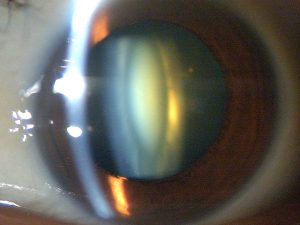
<Preoperative fundus photo> <Postoperative fundus photo>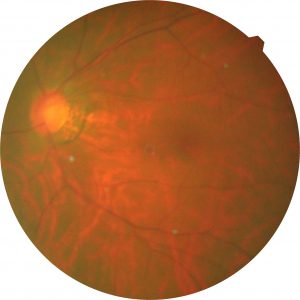
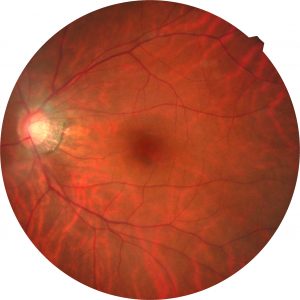
Postoperative eye pressure was lower than before surgery with glaucoma drops, and lower than in the fellow eye still on drops, so we stopped the drops and repeated the visual field test three months after surgery. The MD value, an index of reduced sensitivity in visual field testing (0 is normal; −30 dB is near blindness), was about −4.0 dB before surgery but rose to −1.5 dB after, meaning the 2.5 dB difference in sensitivity loss was actually due not to glaucoma but to cataract. For now no progression of field loss has been confirmed after surgery and eye pressure is good, so being able to stop the glaucoma drops may be one of the benefits of surgery (note that once glaucoma drops are started they usually have to be continued for life, so when prescribing them for the first time we judge the need very carefully, and unless it is urgent we never start them on the basis of a single examination).
There is no clear standard for multifocal lens candidacy in glaucoma, and opinions are divided. The reason for unsuitability is that people with glaucoma have reduced sensitivity from nerve fiber loss, so multifocal lenses, which lose light energy, are considered a disadvantage. Past reports found that, compared with monofocal lenses, bifocal lenses reduced sensitivity by about 2.0 dB, while extended depth of focus lenses showed no significant reduction. In extreme terms, a patient with glaucoma at −28 dB, on the verge of blindness, could reach −30 dB and become blind because of a bifocal lens, and this is the risk and disadvantage of using multifocal lenses.
Published light energy loss is about 18% for bifocal lenses and about 8% for extended depth of focus lenses, but bifocal lenses further split that light half and half between distance and near, so besides the loss from the lens itself, the effect of reduction by splitting must also be considered. Trifocal lenses, for example, have a clever structure with a light energy loss of 12%, better than bifocals, but they split the light a quarter each among 40 cm, 60 cm, 120 cm and distance, so this point also needs full consideration when using them.
In glaucoma staging by visual field, generally MD 0 to −6.0 dB is early, −6.0 to −12.0 dB moderate, below −12.0 dB advanced, and −30 dB near blindness. When visual field results are explained to patients, they are often shown as a diagram with the areas not seen in black, for easy visual understanding, but in fact they are evaluated in fine detail by numbers such as the MD value; from the rate of decline in MD, one can assess whether the current drops have halted progression, and even calculate in how many years blindness would occur. So when you are examined, rather than vaguely thinking "the black areas seem to have grown," we recommend knowing your own MD value; at our clinic, too, we explain not only with diagrams but with MD values and the MD decline curve.
That was a long preamble, but for people with advanced glaucoma in whom a 2.0 dB loss of sensitivity would matter, multifocal lenses should of course not be used; although there is no clear medical evidence, our clinic does not use multifocal lenses in people with glaucoma progressed to moderate or beyond (−6.0 dB or worse), even if eye pressure is well controlled. However, for people like this patient, with early glaucoma at an MD of about −4.0 dB, no central sensitivity loss, sensitivity loss predicted to be mainly due to cataract, and good pressure control with a single eye drop, I think an appropriate multifocal lens may be used. One could argue that even if a −4.0 dB patient lost 2.0 dB with a bifocal lens, they would remain just within the early range of −6.0 dB; but in actual practice, the increase in sensitivity from removing the cataract usually almost cancels out the reduction from the multifocal lens, or more often actually raises sensitivity (*depending on the degree of cataract).
Many people may think multifocal lenses are impossible because they have glaucoma, but even the same 2.0 dB loss weighs differently for someone with early glaucoma at an MD of −3.0 dB and someone with advanced glaucoma at −20 dB. This is purely my personal view, but for people in whom, from their age, treatment history and rate of progression, that loss of sensitivity is unlikely to become a major future risk or disadvantage, there may be no need to give up on multifocal lenses as long as an appropriate lens is chosen, so if this applies to you, please do consult your doctor.
2022.03.09