
About three months have passed since we began using, ahead of its general release, the PanOptix Pro, the upgraded successor to PanOptix, the world's most widely used trifocal lens. Here we present our clinic's first PanOptix Pro case (a standard case), including our impressions of using it.
1. Introduction: a standard PanOptix Pro case
The patient is a woman in her 70s who first visited us in 2018 for itchy eyes and a consultation about glaucoma. OCT showed slight thinning of the nerve fiber layer, so since then we had been following her regularly for preperimetric glaucoma (PPG: a state in which OCT shows abnormalities suggesting glaucoma, such as glaucomatous optic disc findings, but visual field testing shows no defect; roughly, glaucoma before visual field loss appears).
Her intraocular pressure was normal, but because she had hyperopic eyes with narrow angles, we had recommended relatively early cataract surgery in view of the risk of an acute glaucoma attack. In September 2025, seven years after her first visit, she finally decided to have surgery.
2. Background to the lens choice: stage reading and the PanOptix Pro
In the preoperative questionnaire she wished for multifocal lenses. Because she did not want to wear reading glasses when reading aloud on stage for her work, her priority of distances was intermediate > near > far. Prioritizing intermediate and near meant excluding extended depth of focus (EDOF) lenses, so we recommended choosing among multifocal lenses of trifocal or higher with proper intermediate and near add powers.
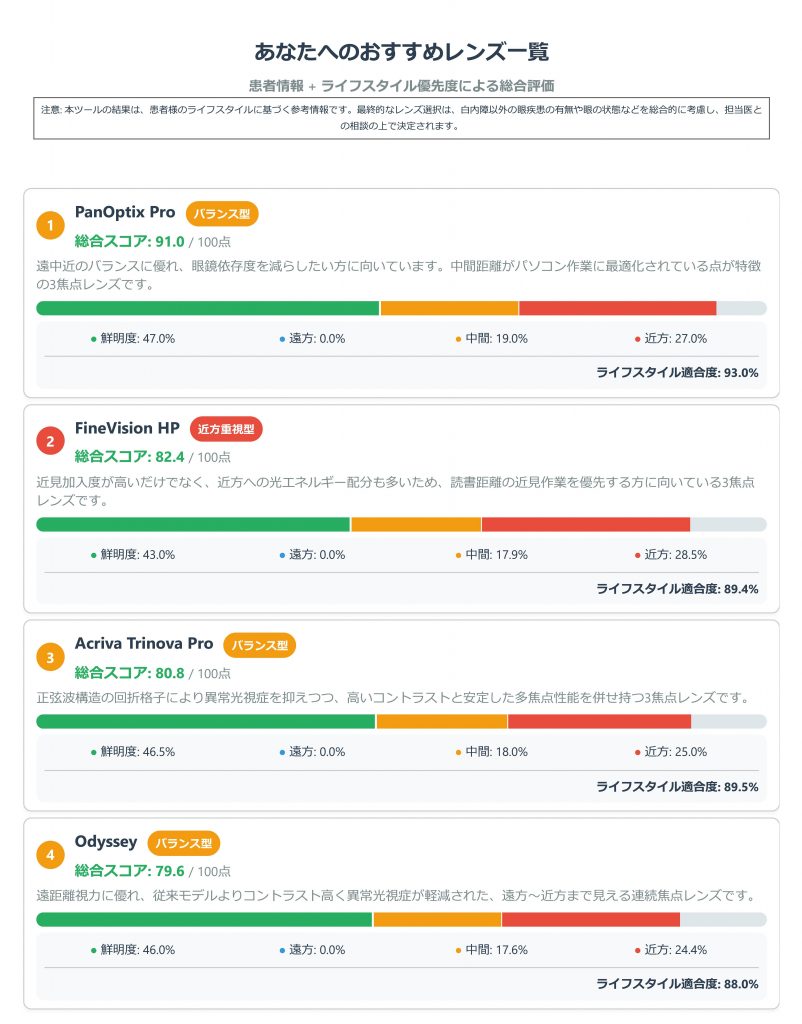
No visual field abnormality had appeared since her first visit, so we first asked her to consider PanOptix, a trifocal lens with a proven track record and reliable near vision, and began preparing for surgery. In the meantime, we were informed that we could use the PanOptix Pro, the upgraded successor to PanOptix, ahead of its release (for details of the PanOptix Pro, see https://morohoshi-ganka.com/news/2157, Japanese). We explained that, through its optic design, the PanOptix Pro keeps light energy loss to 6% (12% for the conventional model), the best level for a diffractive lens, enabling better contrast and intermediate vision, which matched her needs exactly. We also had her complete our lens selection support tool to visualize her specific wishes, and the PanOptix Pro again had the highest lifestyle fit, at 93.0% (see figures below). Fully convinced, she agreed to surgery with the PanOptix Pro.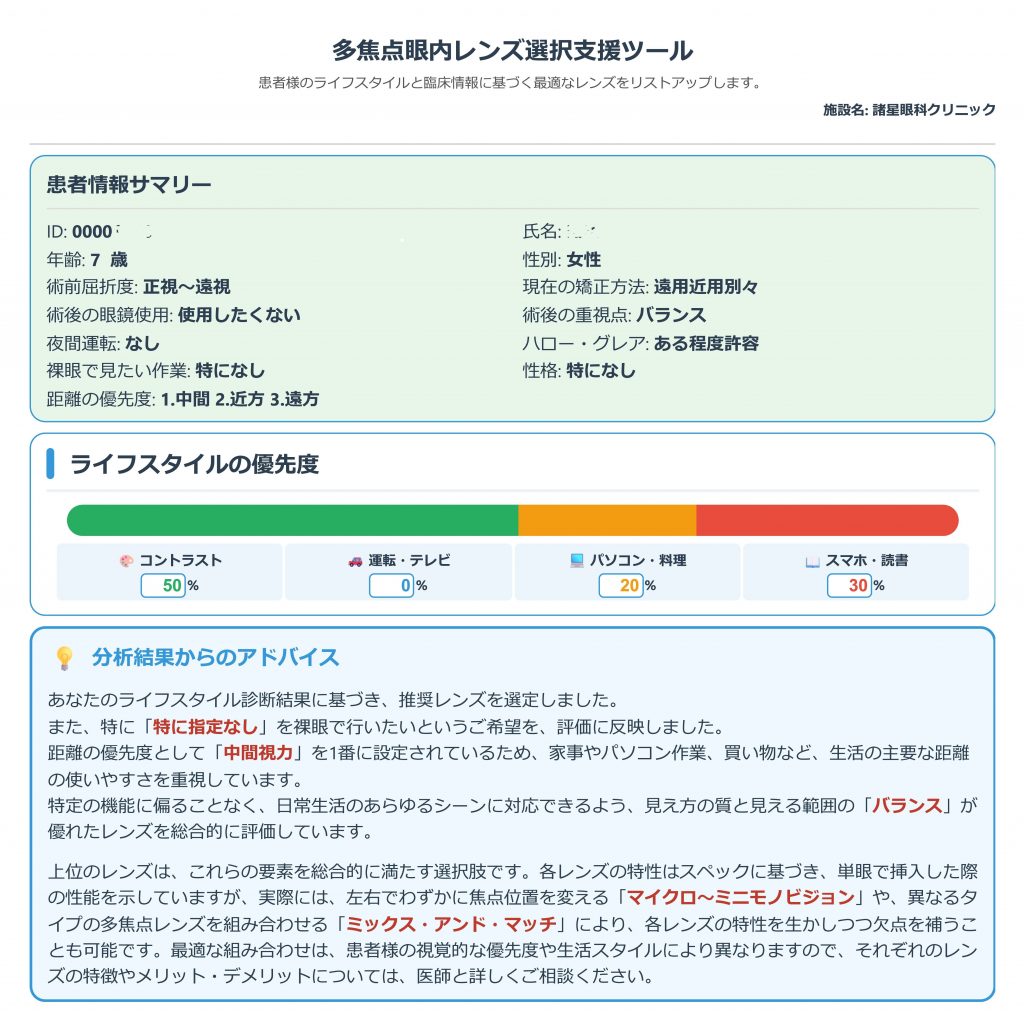

3. Left eye surgery and power selection: aiming for a target refraction of 0.0 D with the ORA system and a regression formula
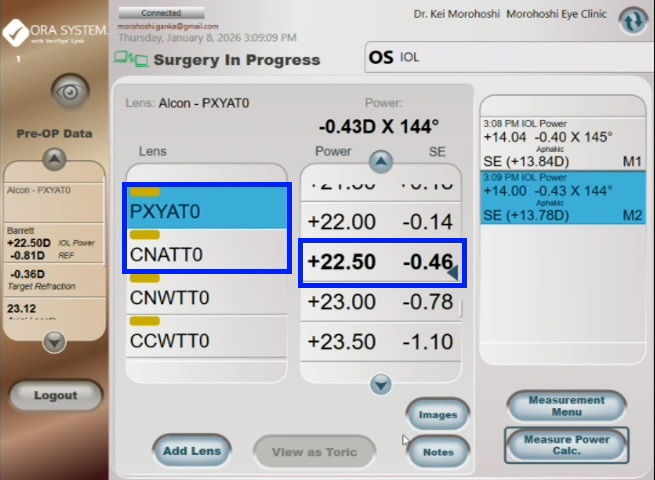
The cataracts consisted mainly of cortical opacity with little difference between the eyes, so we started with the left eye, the non-dominant eye with poorer uncorrected distance vision. Axial lengths were unremarkable, in the low 23 mm range in both eyes, and several preoperative power calculations gave similar results, but to be safe we prepared two lenses for surgery: +22.0 D for exact distance focus and +22.5 D, one step toward myopia.
For the left eye, since this was the first time our clinic used the PanOptix Pro (PXYAT0), we considered the lens power while also displaying the values for the conventional PanOptix (CNATT0), just in case.
As noted above, the preoperative tests indicated +22.0 D. However, based on the intraoperative results from the ORA system shown below, and on a regression formula using our past intraoperative total aberration values and ORA's predicted refraction, we finally chose the +22.5 D lens, for which ORA predicted a postoperative refraction of −0.46 D.
Unlike EDOF lenses, diffractive trifocal lenses keep photic phenomena to a minimum when set for exact distance focus, that is, targeting 0.0 D, so shifting the power unnecessarily is usually not recommended. In other words, by regression analysis of our past surgical data on the gap between ORA's predictions and actual results, we deliberately chose the lens displayed as −0.46 D rather than the +22.0 D lens targeting −0.14 D, so that the eye would actually land on 0.0 D (spot on).
4. Right eye surgery and changes in vision: near vision as expected and life without glasses
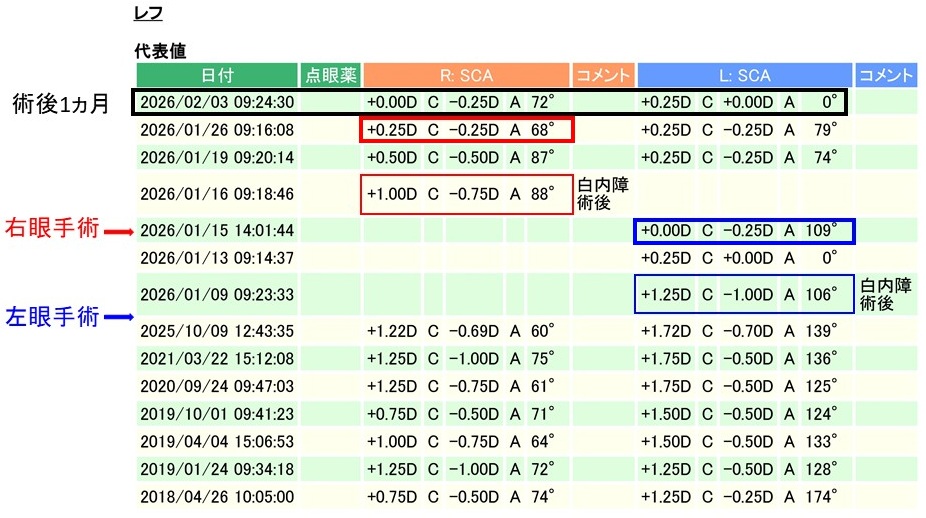
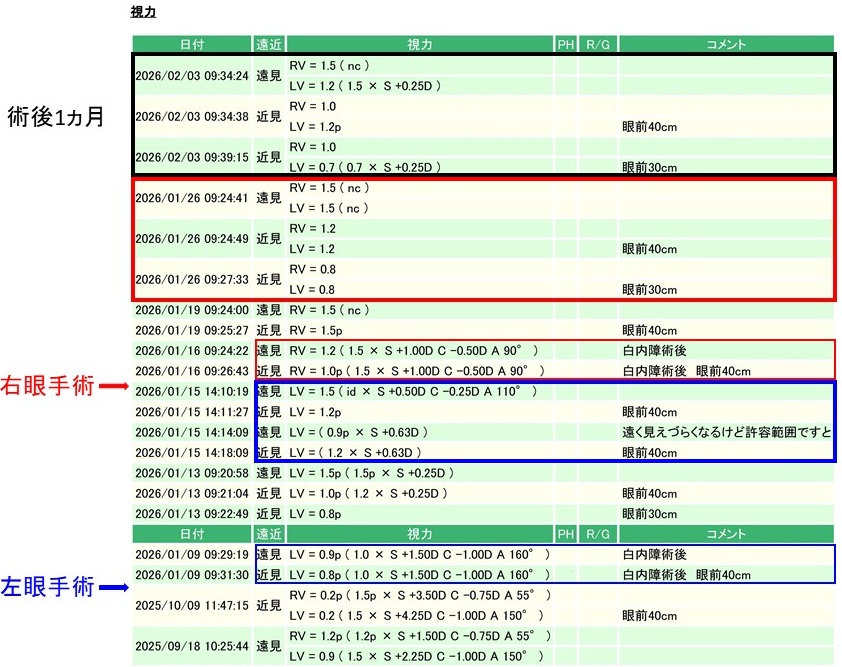
Although we chose a lens targeting −0.46 D as described, the left eye was hyperopic at +0.75 D on the day after surgery (thin blue frame in the figure below). By 1/13, day 5 after surgery, the hyperopia had improved, and on 1/15, one week after surgery and the day of right eye surgery, refraction was −0.125 D, almost exactly 0.0 D as expected (thick blue frame in the figure below), with vision of 1.5p distance / 1.2p near, as the specifications promise. We also ran a simulation shifted slightly toward near, just in case, but distance vision dropped to 0.9p, so we decided to set the right eye, like the left, exactly at 0.0 D, aiming for binocular summation. Even so, intraocular lenses are made in 0.5 D steps, so the eyes cannot be matched down to the decimal places. When a slight difference in refraction will occur, our clinic therefore confirms in advance whether the patient would, if anything, prefer slightly better distance or near. She preferred, if anything, slightly toward near.
 For right eye surgery, we selected the power in the same way and used the +21.5 D lens targeting −0.55 D proposed by the ORA system, shown below.

The right eye was also hyperopic at +0.675 D on the day after surgery (thin red frame in the autorefraction figure above), but, like the left eye, it was +0.25 D on day 4 and +0.125 D on 1/26, day 11, almost exactly 0.0 D (thick red frame in the autorefraction figure above).
As for the change in vision, as shown below, she achieved 1.5–1.2 at distance, 1.2–1.0 at near 40 cm, and 1.0–0.7 even at near 30 cm. With not only good distance vision but also near vision as expected, she was very pleased that she could now do her reading work without glasses.
Since the toric PanOptix Pro (PanOptix Pro Toric) (Japanese) also became available ahead of release, our clinic has already used many PanOptix Pro lenses. With the conventional PanOptix, achieving 1.0 at 30 cm was rare, so I strongly feel that the PanOptix Pro gives better near vision (vision at closer distances). We do not measure visual acuity at 1 m, but we have also heard reports of improved vision around 1 m, which has been a weak point of trifocal lenses.
5. Technical note 1: how a 6% light energy loss reduces photic phenomena
Beyond that, I believe the biggest difference and advantage over the conventional model is that light energy loss is kept to 6% (12% for the conventional model). The reasoning is as follows. Given diffraction efficiency across visible light and the luminous efficiency of the human eye, the light utilization of a diffractive lens has a mathematical upper limit of around 94%–95%. In other words, optical theory makes a loss of about 5% unavoidable. To this is added about 1% loss from geometric scattering, due to the limits of machining the diffractive edges. So the PanOptix Pro's 6% light energy loss can be said to have reached the current physical limit for a single-layer diffractive lens. It is easy to understand that raising light utilization from 88% to 94% contributes to better contrast, but more noteworthy is the reduction in photic phenomena from light energy loss falling from 12% to 6%, that is, being halved. Lost light does not vanish inside the eye: light diffusely reflected at the diffractive edges and light sent to unintended higher or lower orders falls randomly across the whole retina as scattered light. This scattered light becomes noise, like a thin veil over the whole field of view, amplifying the haze around light sources at night (glare) and reducing contrast sensitivity. In other words, raising light utilization (reducing loss) directly reduces the total amount of this physical noise light, so the PanOptix Pro can be expected to produce fainter glare and halos than the conventional model; indeed, we have heard reports that halos became faint enough in brightness not to be bothersome.
Here, a brief note on the difference between the photic phenomena halo (rings) and glare (scatter). A halo is a "ring" seen around a light source; it is the "image at an out-of-focus distance (a blurred circle)" that a multifocal lens creates by design. Because of the multifocal structure, it always occurs, even if light utilization were 100%. Glare, on the other hand, is "dazzle, brightness or haze" around a light source; its main cause is the "scatter loss" described above, and it can also arise from noise unrelated to the lens, such as dry eye or vitreous opacities, even with a monofocal lens with 100% light utilization.
Recently, we used the PanOptix Pro in the left eye of a patient whose right eye had been operated on elsewhere with the conventional PanOptix. Once things settle after surgery, we will ask about her real impressions of the differences between the eyes (in halos, glare and contrast) and report them.
6. Technical note 2: comparison with EDOF lenses, and reliability
More and more patients have recently asked for EDOF (extended depth of focus) lenses, but to maximize the range of clear vision with EDOF lenses in both eyes, careful optimization for each case is essential. In contrast, with the PanOptix Pro, accurately hitting the target refraction gives multifocal vision from distance to near as per the specifications. EDOF lenses have the advantage of greater tolerance to refractive error (vision holds up even with some deviation), but for surgeons who can select lenses and operate with high precision, the PanOptix Pro, with its reliable and reproducible good distance, intermediate and near vision, can be the easier lens to work with.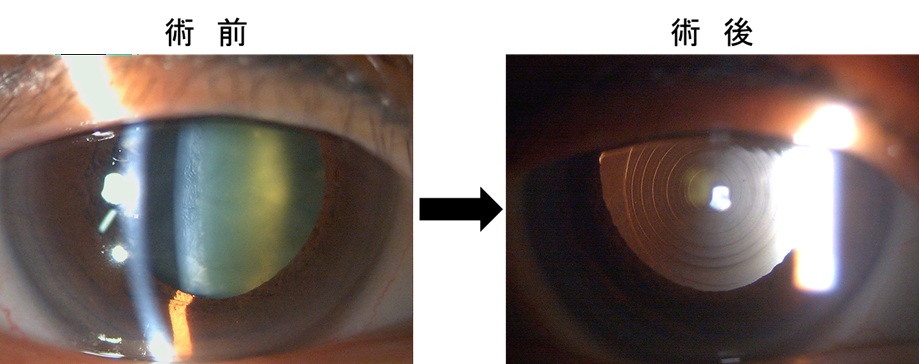
7. Comparison with a next-generation lens: the optics and weak points of enVista Envy
Almost a year has passed since the PanOptix Pro was introduced first in the US in May 2025, and much real-world clinical data has already accumulated; its reliable vision from distance to near is highly regarded. Even so, photic phenomena are still a problem in some cases, and Bausch + Lomb's enVista Envy, another diffractive trifocal lens with fewer photic phenomena, seems often to be used as an alternative. Its diffractive zone covers the central 4.5 mm of the lens, the same as the PanOptix Pro, but considering that its diffraction grating has 22 steps, more than the PanOptix Pro's 15, one might expect more photic phenomena. On the other hand, by smoothing the diffractive steps and having them disappear toward the periphery (apodized design), it increases the share of light energy for distance and allows only the purely refractive periphery to be used in dim conditions, when the pupil is large (3.5 mm or more), thereby reducing photic phenomena at night. The trade-off is that near vision tends to fall in dim conditions. In contrast, the PanOptix Pro's ENLIGHTEN NXT technology forcibly maintains a 50% distance / 50% intermediate-near split up to a pupil diameter of 4.5 mm, so its design keeps near vision from dropping even in relatively dark rooms.
8. Differences in lifestyle between Japan and the US: why the PanOptix Pro suits Japanese life
enVista Envy is attracting attention as a next-generation lens, but in choosing a lens, differences in lifestyle between countries and cultures must be considered.
The US is overwhelmingly a car society, and one of patients' biggest complaints is "halos and glare (photic phenomena) when driving on highways at night." For this reason, in the US, night vision is the top priority, and there are reports of resolving dissatisfaction by exchanging PanOptix for the Envy, which suppresses photic phenomena.
In urban Japan, however, people are not as dependent on cars, and relatively few drive long distances at night. Moreover, owing to physique and culture, the Japanese "reading distance" is closer than that of Westerners (about 30–40 cm), and people read complex kanji on smartphones and in books, so "reliable near focus" tends to be valued.
With the Envy (apodized design), which sends light to distance when the pupil widens in dim places, near vision has a weak point in dim Japanese bedrooms and living rooms. In contrast, the design of the PanOptix Pro, which reliably distributes light to near at any brightness and, with its high light utilization (6% loss), makes fine print up close look sharp, may in fact match Japanese lifestyles and needs very rationally.
9. Summary: the best lens choice starts from a thorough lifestyle analysis
New multifocal lenses will keep appearing, but there is no simple answer as to which lens is best. What is best is completely different for each person, depending on their living environment and hobbies. Without being swayed only by the latest trends and specifications, our clinic thoroughly analyzes each patient's lifestyle and proposes the best lens for a once-in-a-lifetime surgery. If you are unsure about lens selection, please consult us.
10. Reference: comparison table of diffractive multifocal lenses
For reference, here is a specification comparison of diffractive lenses: the penta-focal INTENSITY, the trifocal PanOptix Pro, and the likewise trifocal enVista Envy.
| Item | Intensity | PanOptix Pro | enVista Envy |
|---|---|---|---|
| Design | Penta-focal Diffractive trifocal-plus ≈ penta-focal lens based on the proprietary DLU algorithm | Trifocal Diffractive trifocal lens with ENLIGHTEN NXT technology | Trifocal (full range) Hybrid design with ActivSync technology: apodized diffractive anterior surface, refractive posterior surface |
| Diffractive steps and area | 12 steps / 6 mm (entire optic) | 15 steps / central 4.5 mm of the optic | 22 steps / central 4.5 mm of the optic (edge smoothing with ClearPath technology) |
| Material and color | 25% hydrophilic acrylic Color: natural yellow Close to clear, suited to people who value color vividness and brightness at night. | Clareon (hydrophobic acrylic) Color: yellow (tinted) A tint close to the natural lens (yellow) that filters harmful blue light; the latest material maintains long-term clarity. | TruSight (hydrophobic acrylic) Color: clear (colorless) Glistening-free, maintains long-term clarity and provides natural color vision. Features precise aberration correction from its refractive posterior surface. |
| Add power | +1.5 D / +3.0 D (two supplementary foci in the intermediate range) | +2.17 D / +3.25 D (focused on practical intermediate and near) | +1.6 D / +3.1 D (set for a modern, mild intermediate and near) |
| Focal distances | Far, 133 cm, 80 cm, 60 cm, 40 cm (continuous coverage with five points) | Far, (120 cm), 60 cm, 40 cm (emphasizes the distances best suited to smartphone and computer work) | Far, about 66 cm, about 40 cm (optimized for desktop computer work and dashboard distance) |
| Light utilization | 93.5% (light scattering 6.5%) | 94.0% (conventional PanOptix: 88%) (light scattering 6.0%; conventional PanOptix: 12%) | Not disclosed (*the design inherently produces baseline scattering of about 12–15%, but edge smoothing suppresses the noise) |
| Energy distribution | Far 45% / intermediate 27.5% / near 27.5% (well balanced across the whole range) | Far 50% / intermediate 25% / near 25% (designed with emphasis on distance sharpness) | [Varies with pupil size (apodized)] Photopic (3 mm): far 40–45% / intermediate 25% / near 30% Dim (4 mm and above): far 75–80% / intermediate 8–10% / near 10–12% |
| Power range | +10.0 D to +30.0 D (toric available) | +6.0 D to +30.0 D (toric available) | 0.0 D to +34.0 D (toric available) |
| Features | Natural vision without gaps: little drop in vision between foci; suited to people who move their gaze a lot, such as with housework indoors or desk work. | Sharp contrast and high satisfaction: light scattering is minimized; especially strong for digital work such as smartphones (40 cm) and computers (60 cm). | Clear vision for both computer work and night driving: in dim conditions it sends light to distance to suppress halos and glare, and in daytime it focuses at the 66 cm computer distance. Near vision in dim places is a weak point. |
2026.03.22