
Contents
Overview / Preoperative findings and wishes / Lens choice and surgery / Postoperative course / Cautions for −3.0 D myopic eyes / Intensity and PanOptix Pro / Specification comparison
Overview
We had not yet published such a case, so here we present a case with Intensity, a diffractive penta-focal lens whose specifications are close to those of the PanOptix Pro, although it is a self-pay lens.
He had noticed difficulty seeing due to cataracts for about two years. In February 2025 he was told he had cataracts at an eye clinic attached to a contact lens shop, and he first visited our clinic for consultation about surgery.
Preoperative findings and wishes
Both eyes had cataracts consisting mainly of cortical opacity, and corrected visual acuity had fallen to 0.6 in both eyes. Since he was moderately myopic at about −3.0 D, I expected his uncorrected near vision to be relatively good, but it had fallen to 0.6–0.7 in the right eye / 0.4 in the left eye (red frame in the figure below).
In the preoperative questionnaire he wished for multifocal lenses. His priority of distances was intermediate > near > far; he enjoys fishing and golf as hobbies and uses a computer a lot at work. In fishing in particular he wanted to see at close range, about 30 cm, so he wished for a lens that would let him see up close while causing less light spreading (unpleasant photic phenomena at night).
As we have always explained, seeing up close (a wide range of focus) and having fewer photic phenomena at night conflict with each other. After explaining this, and giving weight to the importance of near vision, we first suggested FineVision HP, which is covered under the elective treatment (senteiryouyou) system.
Lens choice and surgery
As we continued to hear what he wanted from a lens, he told us he was also open to fully self-pay treatment. We therefore asked him to consider Intensity, a penta-focal lens that reliably provides vision at 30–40 cm, offers among the highest contrast of diffractive lenses, and has relatively few unpleasant photic phenomena at night such as halos and glare. He reconfirmed that his lifestyle requires seamless vision at every distance, from fishing, where he needs to see 30 cm, to intermediate computer work and distance for golf, and he finally chose surgery with Intensity.
The cataracts did not differ much between the eyes, but after discussion, since the right eye was dominant, he agreed that we would operate on the left eye first, whose near vision was worse both subjectively and on testing.
In left eye surgery, as usual, we referred to the results of intraoperative wavefront aberrometry with the ORA system, chose the more distance-oriented of two lenses prepared in advance, and also inserted a capsular tension ring (CTR) for long-term stability. The surgery was completed without any notable events.
Postoperative course
After left eye surgery, as shown below, there was no refractive error, and from the next day he was delighted with his excellent uncorrected vision at both distances: 1.5 distance / 1.2 near (blue frame LV in the figure below).
Next, regarding the target refraction for the right eye: intraocular lenses are made only in 0.5 D steps, so it is impossible to match the left eye's refraction down to the decimal places. In other words, a very small difference of about 0.1–0.3 D will always arise. We always explain this to patients and confirm in advance "whether, if anything, they would prefer slightly better distance or slightly better near" before choosing the lens power. In his case, I personally thought the left eye's near vision was sufficient, but he wished the right eye to be slightly more toward near. In the end he agreed to a lens of the same power as the left eye's in the right eye, giving a natural difference between the eyes that preserved the difference that had presumably existed before the cataracts. Some patients come to us wanting their dominant eye set more toward distance based on knowledge from YouTube and similar sources, but for focus, the dominant eye does not necessarily need to be set for distance. In real practice, the eye that was originally more myopic (that is, with the longer axial length) is often the dominant one, and setting targets that follow the original difference between the eyes causes less discomfort after surgery than reversing it. With mix-and-match, on the other hand, using an extended depth of focus (EDOF) lens in the dominant eye reduces unpleasant photic phenomena at night, so as a rule we do not recommend a diffractive lens in the dominant eye.
As for how far to shift the right eye toward near, as shown in the yellow frame in the figure below, a simulation shifted +0.25 D toward near gave 1.2 distance / 1.5p near. Shifting +0.50 D toward near made 30 cm easier to see than 40 cm, but distance vision fell to 0.7, so he agreed to target a shift toward near of no more than 0.25 D.
Changes in visual acuity
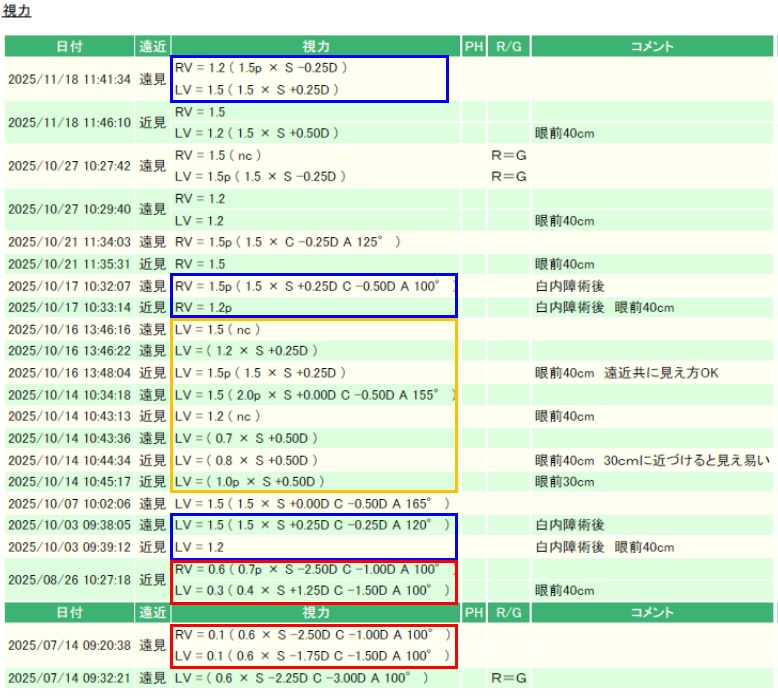
For right eye surgery, intraoperative wavefront aberrometry likewise showed the same difference between the eyes as the preoperative tests, so we could decide the lens power with confidence. We also used a CTR, and the surgery was completed without problems.
The right eye also had good uncorrected vision from the day after surgery, 1.5p distance / 1.2p near, and at 1 month it was 1.2 distance / 1.5 near, slightly better near vision than the left eye, as intended. He also felt that near was easier to see, and he was delighted with a life of seamless vision from distance to near without glasses (blue frame in the figure above). Some argue that the target refraction should not be shifted with diffractive lenses, but as long as it is not excessive, as in his case, the focal point shifts by as much as the lens power is shifted, so the shortcomings of one eye can be covered. For example, a postoperative refraction of +0.25 D and −0.25 D give almost the same distance vision, but near vision is much better at −0.25 D.
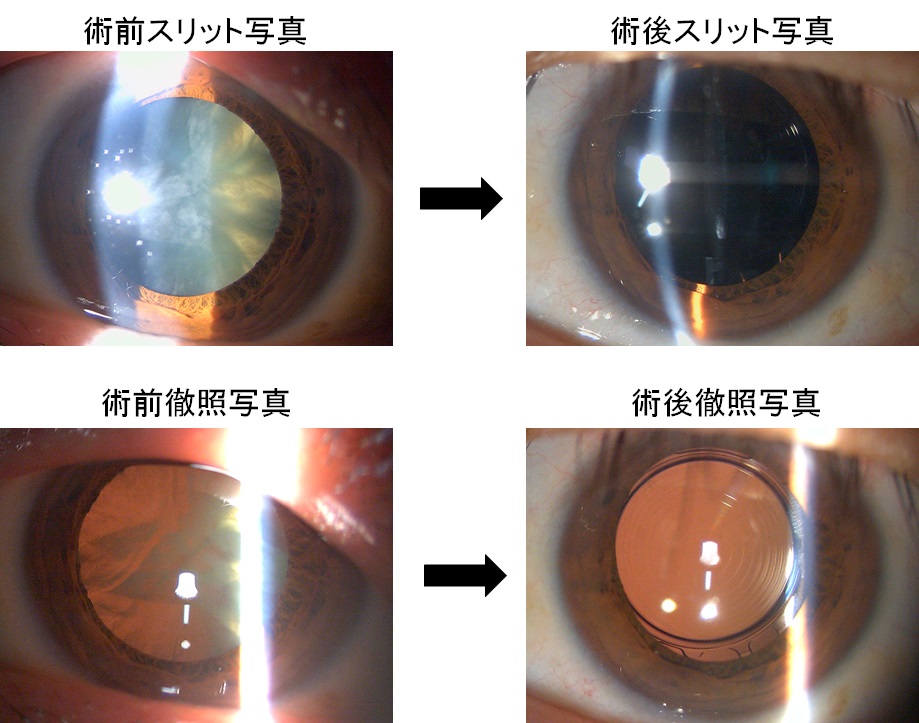
Cautions for −3.0 D myopic eyes
When people with moderate myopia like him, whose preoperative refraction of −3.0 D gives focus at 33 cm, choose a multifocal lens, particular care is needed (Japanese) in the preoperative explanation and lens choice. This is because almost no multifocal lens focuses sharply at 30 cm. In other words, a distance that was easy to see before surgery may become harder to see after it, and among people who come to us with problems after surgery, quite a few are dissatisfied because "close distances I could easily see before surgery have become hard to see." Removing the cataract's opacity often improves visual function, but depending on the choice, the near focal point may be sacrificed, and explaining and understanding this beforehand is essential. For patients, even one aspect that feels worse after surgery than before can lead to dissatisfaction. His preoperative near vision was clearly reduced, so we were able to achieve a highly satisfying result. On the other hand, choosing the type and power of a multifocal intraocular lens without measuring and evaluating near vision before surgery, both with one's usual correction and without correction, can create a gap from preoperative expectations and become a major cause of problems after surgery; in that case, we recommend consulting your doctor again.
Intensity and PanOptix Pro
In my experience, the conventional PanOptix rarely gives near vision of 1.5 even when the refraction is spot on. Whether Intensity is a penta-focal or a trifocal-plus lens is debatable, but its specified focal distances are far, 133 cm, 80 cm, 60 cm and 40 cm. Its feature is that, rather than reallocating distance light to intermediate and near as PanOptix does, it reallocates the 80 cm intermediate light to distance and near, increasing the share of light energy for near; this seems to contribute to its good near vision.
However, although Intensity reduces light energy loss to 6.5% and suppresses unwanted scattering, its diffractive structure covers the entire lens surface, so photic phenomena at night are unavoidable. In fact, our clinic has performed lens exchange to relieve postoperative waxy vision in a patient who had received Intensity at another clinic. The PanOptix Pro, on the other hand, has a light energy loss of 6%, among the lowest for diffractive lenses, and its diffractive structure is confined to the central 4.5 mm of the lens, so halos, glare and other photic phenomena at night can be expected to be even lower. The number of diffractive steps must also be considered, however: the PanOptix Pro has 15 steps versus 12 steps for Intensity, so the density of diffractive steps is also higher, and it is difficult to evaluate the lenses only by the area of the diffractive structure. In any case, a major feature of Intensity is that it creates five foci with a diffractive structure of only 12 steps. Our clinic has already started using the PanOptix Pro. I cannot tell much difference in photic phenomena at night, but my impression is that near vision recovers more quickly after surgery than with the previous conventional PanOptix, and we have obtained very good near vision results of 1.5 distance / 1.5p near. We also have upcoming surgery using the PanOptix Pro in the other eye of a patient who had the conventional PanOptix implanted at another clinic, and we will update this information as it becomes available.
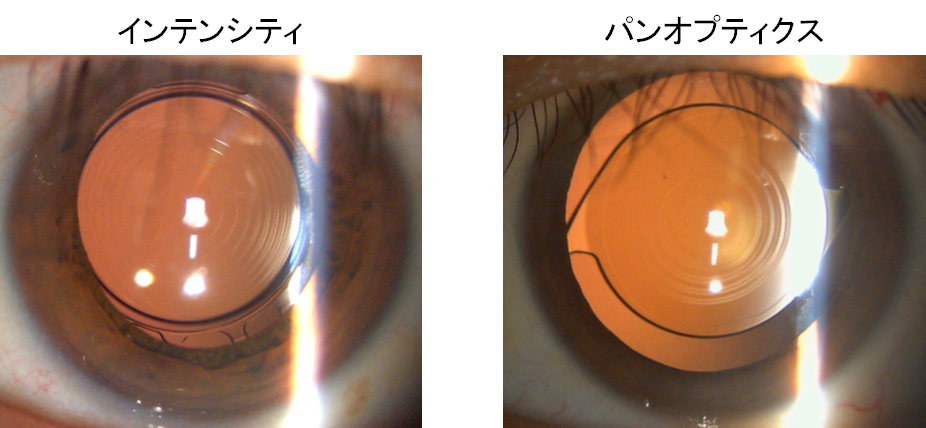
Comparison of Intensity and PanOptix Pro
We have digressed into the PanOptix Pro, but Intensity offers high contrast among diffractive lenses and suits people who want to see at all distances without glasses, especially those who want reliable near vision. As we have pointed out before, its specifications have much in common with the PanOptix Pro, so finally we provide a table comparing the specifications of the two for anyone interested. Intensity HP, made of hydrophobic acrylic, is expected to become available in Japan soon.
| Item | Intensity | PanOptix Pro |
|---|---|---|
| Design | Penta-focal Diffractive trifocal-plus ≈ penta-focal lens based on the proprietary DLU algorithm | Trifocal Diffractive trifocal lens with ENLIGHTEN NXT technology |
| Diffractive steps and area | 12 steps / 6 mm (entire optic) | 15 steps / central 4.5 mm of the optic |
| Material and color | 25% hydrophilic acrylic Color: natural yellow Close to clear, suited to people who value color saturation, sharpness and brightness at night. | Clareon (hydrophobic acrylic) Color: yellow (tinted) A tint close to the natural lens that filters harmful blue light. The latest material maintains long-term clarity. |
| Add power | +1.5 D / +3.0 D (two supplementary foci placed in the intermediate range) | +2.17 D / +3.25 D (focused on practical intermediate and near) |
| Focal distances | Far, 133 cm, 80 cm, 60 cm, 40 cm (continuous coverage with five points) | Far, (120 cm), 60 cm, 40 cm (emphasizes the distances best suited to smartphone and computer work) |
| Light utilization | 93.5% (light scattering 6.5%) | 94.0% (conventional PanOptix: 88%) (light scattering 6.0%; conventional PanOptix: 12%) |
| Energy distribution | Far 42% : intermediate 25.75% : near 25.75% (well balanced across the whole range) | Far 48% : 24% : near 24% (designed with emphasis on distance sharpness) |
| Power range | +10.0 D to +30.0 D (toric available) | +6.0 D to +30.0 D (toric available) |
| Features | Natural vision without gaps: little drop in vision between foci; suited to people who move their gaze a lot, such as with housework indoors or desk work. | Sharp contrast and high satisfaction: light scattering is minimized; especially strong for digital work such as smartphones (40 cm) and computers (60 cm). |
2026.01.21