
Now that we have decided to start using the PanOptix Pro, here, for the first time in a while, is a brief case with the standard PanOptix.
She had been told of a cataract in her left eye a year earlier at a contact lens check-up at another clinic, and first visited us without a referral letter in July 2025.
Since she was highly myopic, I expected a myopic nuclear cataract, but she had a single-eye (left) anterior subcapsular cataract extending into the pupillary area, and corrected visual acuity had fallen to 0.7. She usually wears multifocal contact lenses, and the right eye had good vision of about 1.2p at both distance and near, so we explained that surgery on the left eye alone would be sufficient for now. She was also considering multifocal lenses, so we gave her the preoperative questionnaire and asked her to stop wearing soft contact lenses for at least three days before returning, so that we could judge her candidacy for multifocal lenses.
Corneal topography at the retest showed low higher-order aberrations, confirming that the multifocal effect could work well in her eye. In the questionnaire she had chosen "I want to avoid glasses as much as possible," "I value a wide range of focus," and "I drive at night frequently." As we have always explained, "range of focus" and "no halos or glare at night" are in a trade-off relationship, so we explained that she would have to accept some compromise on one or the other. She said that, as a pharmacist, she wanted to prioritize seeing the small print on prescriptions. In the preoperative questionnaire and in our clinic's original multifocal lens matching app shown below, Acriva Trinova Pro was the top recommended lens, but her priority for sharp vision was far > near > intermediate, so she agreed to surgery with PanOptix, which allocates half of its light energy to distance, maintaining good distance vision while reliably providing vision at near 40 cm.
It was a single-eye anterior subcapsular cataract, possibly traumatic, but the anterior capsulotomy and lens removal went without problems. As usual, we chose the power based on intraoperative wavefront aberrometry with the ORA system, and the surgery itself went smoothly.
After surgery she had good uncorrected vision of 1.2 or better at both distance and near from the next day, and in the postoperative questionnaire she was delighted that she could see the small print on prescriptions at work clearly without glasses.
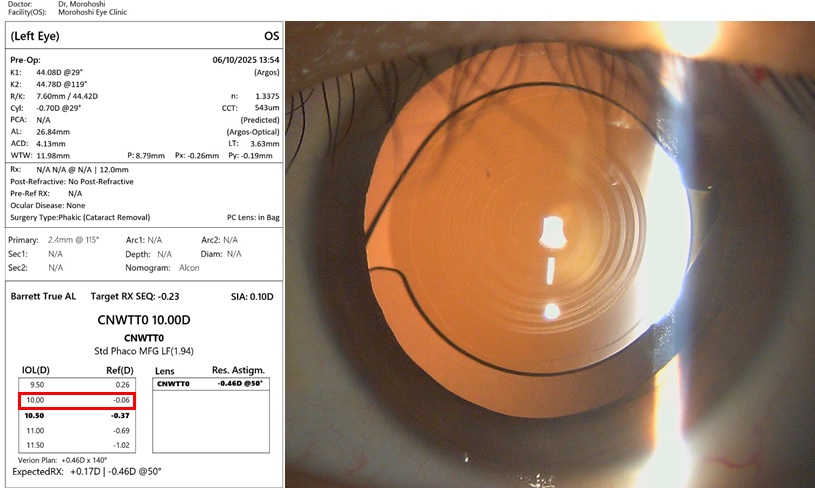
As in her case, as long as we perform (1) an accurate judgment of multifocal candidacy, (2) a lens choice suited to the patient's lifestyle, and (3) accurate lens power selection (keeping postoperative refractive error as small as possible), I think it is not very difficult to obtain good vision matching the specifications with any multifocal lens. Conversely, cases of dissatisfaction after multifocal surgery mean that one of these went wrong. Personally, (3) is the eternal number-one challenge, but I also feel it is something a facility can improve through its own efforts.
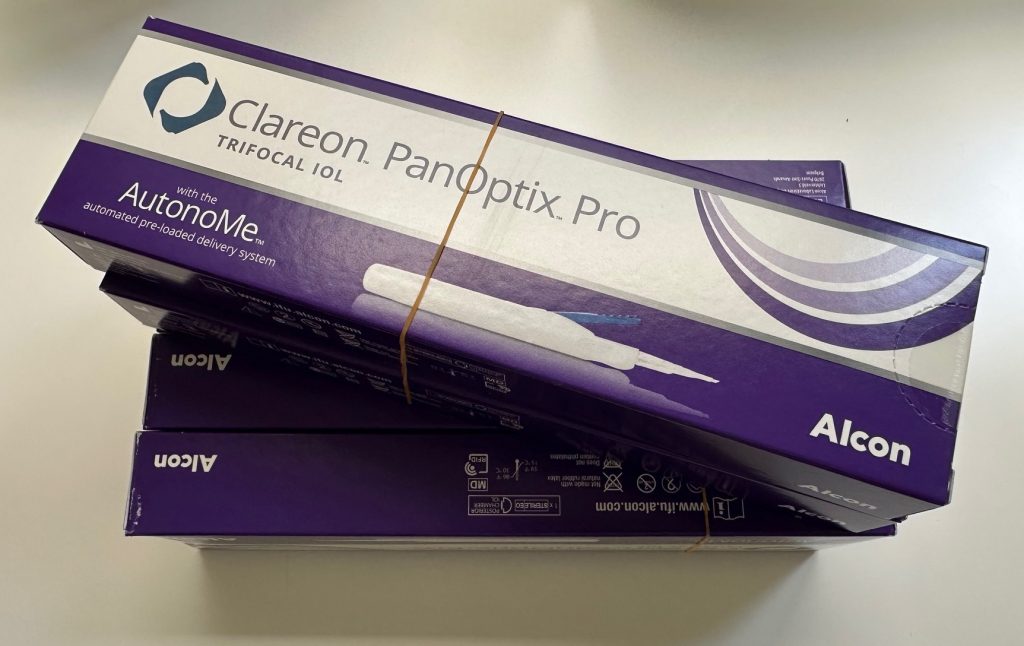
PanOptix can provide fully satisfying visual function, as in her case, but its upgraded successor, the PanOptix Pro, has even less light energy loss, so we can expect better contrast and near vision and fewer photic phenomena at night such as halos and glare. We plan to use it from the new year, and the PanOptix Pro has already arrived at our clinic, as shown below, so we will report our impressions as they come.
Finally, introducing our tool. Points (1) and (3) above depend largely on the power of medical equipment and the facility's expertise, but for (2), the patient's cooperation and a proper understanding of their wishes and priorities are important. Our clinic has therefore created an original multifocal lens selection support tool (Japanese) based on patient information, as shown below, and uses it in actual consultations, also as part of history-taking.
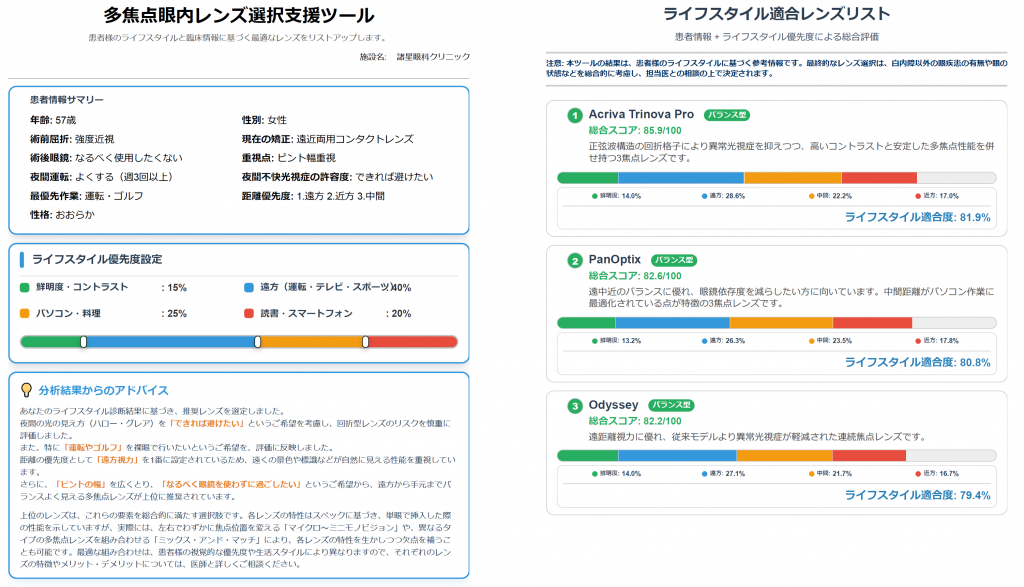
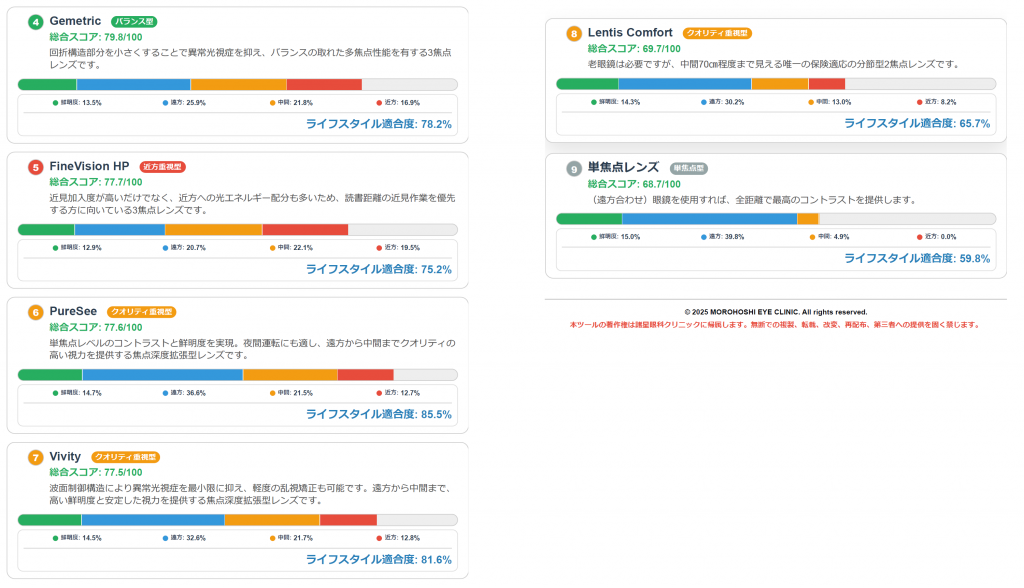
In May 2025, when I half-playfully did a literature-based scoring of multifocal lenses (Japanese), I thought that, since I had the scores, I could use them to match against patients' wishes and create a list of recommended lenses suited to their lifestyle. I built it steadily by hand in spare time such as clinic holidays, and after repeated trial and error the prototype was finished in about a month. I had been verifying its consistency with the cooperation of actual patients like her, but adding monofocal lenses to the lens list caused problems, and it took quite a long time to complete.
In addition to academic scores based on the optical specifications of each lens, it weights various patient information, such as age, personality and lifestyle balance, using our own logic derived from our clinical results with each lens, and displays a recommended list. This judgment process does not use AI (artificial intelligence); it scores objectively with a carefully designed algorithm alone, so it may list a lens you had not even considered, one that logically matches your lifestyle, without being swayed by rumors or trends.
It is easy to imagine that publishing even just the UI would eventually lead to many similar tools, but we believe this tool is useful for patients to organize and confirm their own priorities (wishes for how they see), and we plan to publish it on the web in the future.
At the same time, this tool is an original app planned and developed independently by us. We firmly refuse copying, reproduction, modification or distribution of its UI, such as the patient information fields, its design, structure, logic or algorithm, as well as imitation in a substantially identical form (an outright "copy"). If unauthorized use is found, we may request removal or take other action. We welcome healthy improvement and development that leads to better tools, so if you would like to use it as a reference or introduce it, please contact us in advance.
To prevent results from taking on a life of their own and causing trouble for other clinics, it is currently available only on site (in our clinic) for people considering or scheduled for multifocal lens surgery at our clinic. It can also be used at Mochizuki Eye Clinic, Josuidori in Fukuoka, which cooperated in its development; if you are interested, please contact us.
2025.12.28