
She had already scheduled cataract surgery with multifocal lenses in both eyes at another clinic, but felt uneasy about the lens choice, and first visited us in November 2023 for what was essentially a second opinion, without a referral letter.
Axial length was about 25 mm in both eyes, but the eyes were highly myopic because corneal power exceeded 46 D. In the right eye, myopia had further increased with progression of nuclear cataract, reaching extreme myopia of more than −12.0 D. Corrected visual acuity in the right eye had fallen to 0.7, and, as shown at the far right of the OPD-Scan III image below, the higher-order aberration of the lens typical of nuclear cataract, trefoil, which makes things look tripled, had appeared.
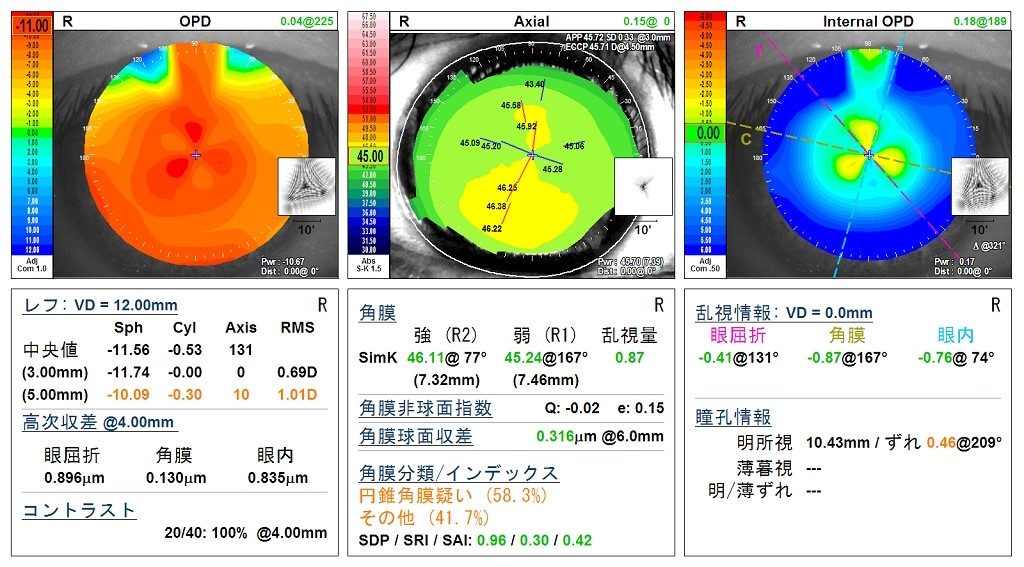
Corneal astigmatism was with-the-rule with a somewhat asymmetric component; as the middle column of the OPD-Scan III image above shows, there was also an inferior-superior asymmetric astigmatic component suggesting a keratoconus element. However, corneal spherical aberration was normal at 0.316 µm, and corneal higher-order aberrations in the left column were low at 0.130 µm, so we judged these to be eyes in which a multifocal lens could function properly.
Her previous doctor seems to have been considering lenses such as PanOptix. In the preoperative questionnaire, however, she wrote: "I would like to avoid glasses as much as possible, but I want to prioritize the quality of vision. If it comes to that, I accept wearing glasses for things like reading," and answered that she valued "distance" most. In the questionnaire about her personality she also chose "perfectionist," and frankly she gave the impression of being very particular about the quality of vision. She understood that in this respect she was not well suited to multifocal lenses, but she still wished to have surgery with them.
Corneal astigmatism was −0.94 to −1.06 D in the right eye and 1.31 to 1.65 in the left, with some variation in the left eye. We explained that careful placement of the incision (incision on the steep meridian) could probably reduce astigmatism sufficiently in the right eye, but the left eye would quite likely need a toric lens, which would limit the choice of lens. On that basis, she wished for a multifocal lens that avoids photic phenomena such as halos and glare and gives good quality of vision. In her own words, she would consider (1) PanOptix in both eyes if contrast and the like were not a problem; (2) if possible, the wavefront-shaping Clareon Vivity in the right eye and, depending on the result, toric PanOptix or Vivity in the left eye; or (3) MiniWELL Ready/PROXA. We gave her time to consider until surgery in March 2024.
Later, during preoperative testing, option (3) MiniWELL Ready/PROXA was ruled out because of the surgery date and lens ordering schedule, and she agonized until the last moment over whether to choose Vivity or PanOptix for the right eye. Six days before right eye surgery she called and said, "I've decided on Vivity!" She also asked what near visual acuity to expect when focused for distance; when we answered that, by Vivity's specifications, it is often around 0.7, she said she would like the target refraction slightly toward near rather than 0 D (infinite distance). The proportion between axial length and corneal power was unfavorable, making these eyes very prone to refractive error, so we prepared Vivity lenses in several powers for surgery.
First, the right eye. Although nuclear hardness was advanced, phacoemulsification of the lens went without problems. We measured twice with the intraoperative wavefront aberrometer (ORA system), confirmed that total ocular astigmatism had decreased to 0.15–0.66, and confirmed that a toric lens was not needed (see figure below). We then selected the lens power using our clinic's regression formula with explanatory variables such as total ocular aberration, and, as shown below, completed the surgery without problems using an 11.0 D Vivity, for which ORA predicted a refraction of −0.60 D, slightly toward near.

On the day after surgery, the right eye's refraction was −0.50 D objective / 0.0 D subjective, and uncorrected visual acuity was 1.5 distance / 0.8 near; she understood this was the vision we had told her to expect before surgery. On day 4, as expected, the eye shifted slightly toward myopia, to −0.875 D objective / −0.25 D subjective, and uncorrected visual acuity changed to 1.2 distance / 1.2 near. She was delighted with distance and near vision better than expected, but because the right eye's result was better than expected, choosing the lens for the left eye became difficult. Naturally she wanted a lens of the same quality as her right eye, that is, Vivity in the left eye too. However, as mentioned above, corneal astigmatism was stronger in the left eye than in the right, so Vivity, for which no toric version was available, might not be usable.
We therefore prepared both a toric PanOptix and a Vivity, and she agreed that we would use the toric PanOptix if total astigmatism on intraoperative wavefront measurement was 1.0 D or more, and Vivity if it was within 1.0 D (ideally within 0.75 D). She also said she was already fully satisfied with near vision in the right eye and wished, if Vivity was used in the left eye, to target it more toward distance than the right eye. We therefore simulated a shift 0.375 D more toward distance than the right eye, which gave uncorrected vision of 1.5 distance / 0.7 near, and after confirming that she could accept the reduced near vision, we set the target refraction for Vivity.
Since a toric lens might be used in the left eye, we began by manually marking the astigmatic axis as a backup in case the ORA system did not work, and by creating the incision at a position and in a manner that would reduce corneal astigmatism as much as possible. The cataract itself was not as hard as in the right eye, so lens removal went more smoothly, and we moved on to measuring total ocular aberration with the ORA system. We measured the left eye twice as well; as shown below, total ocular astigmatism was −0.90 to −0.74 D. We told her this, and after discussion she agreed to Vivity. Likewise, using a 13.0 D Vivity, the power determined from our regression formula using total ocular aberration values and other data, we completed the surgery without problems. (It really doesn't matter, but I noticed afterwards, to my surprise, that the measurement times during surgery were exactly the same in both eyes.)

On the day after surgery, the left eye's objective refraction was +0.125 D with 0.75 D of astigmatism, and subjective refraction was +0.625 D; perhaps because of this slight hyperopic shift, uncorrected vision was 1.2p distance / 0.7 near. By day 10, however, the eye had shifted moderately toward myopia, as expected, to −0.625 D objective / 0.00 D subjective, with no effect from the corneal astigmatism we had worried about, and uncorrected vision reached 1.5p distance / 1.2 near. Here too she was delighted with distance and near vision better than expected. Curiously, although the left eye was set more toward distance and had 0.50 D more astigmatism than the right, its vision ended up better than the right at both distance and near; this may be because moderate with-the-rule astigmatism helps near vision, as also seen with monofocal lenses. In the postoperative questionnaire she was very satisfied, writing that "I can see up close better than I expected," and was delighted that she should be able to resume her work as a tax accountant, currently on hold, comfortably without glasses.
As this case shows, even with Vivity in both eyes rather than a mix-and-match of Vivity and PanOptix, it is possible in some cases to provide a satisfying result by creating a moderate difference between the eyes. But what counts as "moderate" differs from person to person, so care is needed in setting targets.
Recent multifocal lenses (presbyopia-correcting lenses) have become polarized into lenses like Vivity, with few photic phenomena such as halos and glare, which prioritize quality of vision, and lenses that prioritize near distance, letting you see up close. It is therefore very important for patients to tell their doctor their priorities clearly before choosing a lens. In the former group, TECNIS PureSee, a new refractive EDOF lens from J&J with almost the same add power as Vivity, is on the way; in the latter, TECNIS Odyssey, with fewer photic phenomena than TECNIS Synergy, is coming. In particular, TECNIS Odyssey is, so to speak, an upgraded successor to TECNIS Synergy and is expected to become available in Japan as early as this autumn.
Of course, a lens with few photic phenomena that also lets you see up close would be ideal, but unfortunately there is at present no perfect intraocular lens that provides the same visual function as the natural lens. Outside the lenses covered by the elective treatment system, they would be fully self-pay, but Lenstec's ClearView3 (Japanese) and SIFI's MiniWELL Ready seem close to that concept, so if you are interested, please feel free to consult us.
Recently we had a case using an add-on lens version of Evolve, an extended depth of focus lens from Soleko of Italy, which has a weaker near add than MiniWELL Ready but almost no photic phenomena and high quality of vision. We plan to publish it next.
2024.05.29