
He had been told he had cataracts three years earlier and first visited us for consultation about surgery.
He came from Ibaraki Prefecture and, from the first visit, stated his wishes specifically: (1) few halos and glare, because he sometimes drives at night; (2) he wanted to see the computer he uses at work without glasses; and (3) he wanted to see in the distance for golf, but did not mind also using a contact lens. He had already seen a local eye doctor about surgery, and seemed to have come to us for something like a second opinion, so at the first visit we graded the cataracts, assessed the surgical risks and screened for eye diseases other than cataract, and asked him to return if he wished to have surgery at our clinic.
About a month later he returned and booked surgery, so we discussed the lens type and target refraction again. Both eyes had long axial lengths exceeding 26 mm, and with advanced nuclear cataract the preoperative refraction was extreme myopia: −13.5 D in the right eye and −11.5 D in the left. Consistent with his complaint that traffic signal arrows looked like three, preoperative wavefront analysis with the OPD-Scan III (see figures below) showed high internal higher-order aberrations from the cataracts in both eyes, 0.610/0.463 µm. However, corneal higher-order aberrations were low and there was no other eye disease, so we explained that these were eyes in which ordinary multifocal lenses were also an option.
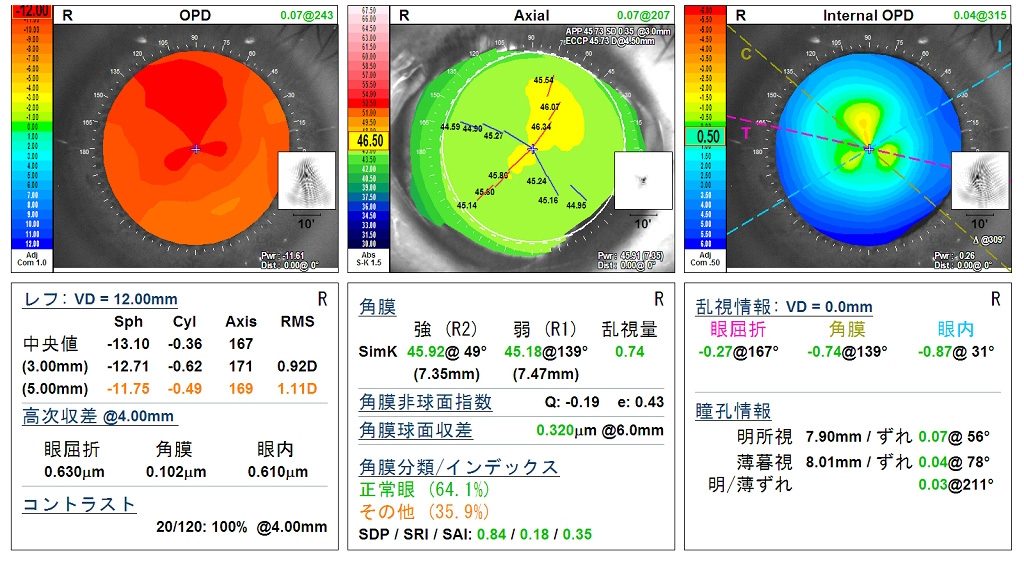
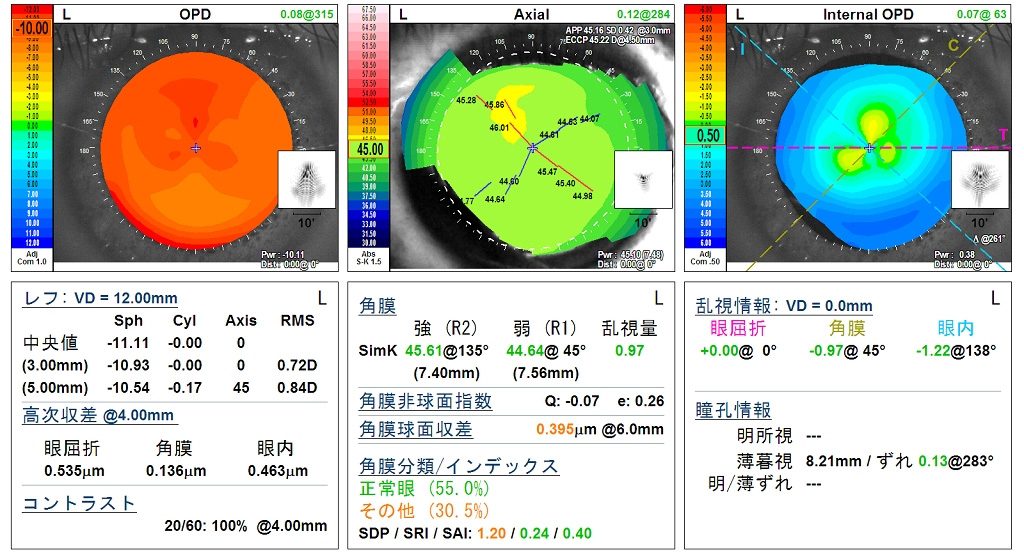
However, because he sometimes drives at night and gave priority to few photic phenomena such as halos and glare, we asked him to choose among three options: a monofocal lens, Eyhance, or LENTIS Comfort.
He was hoping for the greater depth of focus typical of highly myopic eyes, but since that is uncertain, we explained that the lens should not be chosen counting on it from the start, and recommended first setting the target refraction to prioritize the distance he definitely wanted to see without glasses. As a result, unlike his initial wishes, he chose surgery with LENTIS Comfort with a target refraction that would let him see in the distance without glasses, since he did not mind using reading glasses for near.
In people who were originally highly myopic, using LENTIS Comfort, with an add of +1.5 D, set for distance is likely to make close work at about 30 cm, which they could see before, harder to see, so we usually do not recommend it. He fully understood this, and to keep open the possibility of meeting all of wishes (1), (2) and (3), we decided to set the right eye first with a target of 2.0 m for distance, i.e., a refraction of −0.5 D, so that he could see 1.0 or better in the distance, reliably see 50 cm for the computer, and see reasonably well at about 40 cm. Since LENTIS Comfort has an add of +1.5 D, 1.5 D + 0.5 D = 2.0 D → 1/2.0 D = 0.5 m, so 50 cm is the theoretical limit of the near focus. We proceeded with surgery predicting that, with about 0.5–1.0 D of pseudo-accommodation added, he would easily be able to see at about 40 cm.
The right eye had a hard, advanced nuclear cataract, but ultrasound lens removal was completed without problems, and we made the final power choice using the ORA system, an intraoperative wavefront aberrometer. Because the cornea was steep for such a long eye (high corneal power), we were concerned about postoperative refractive error, but the refraction came out as targeted, and the greater depth of focus typical of high myopia that he had hoped for came into play: not only distance but also near vision was good, and he was delighted with uncorrected vision of 1.2 at both distance and near. However, it has been reported that LENTIS Comfort usually shifts slightly toward hyperopia over the postoperative course, so we planned to take that into account when setting the left eye's target. In his case, on the contrary, the eye shifted slightly toward myopia compared with the day after surgery. Uncorrected distance vision was still 1.2 or better, and when we discussed the target for the left eye, he said near vision was sufficient and, hoping for a binocular summation effect, wished for a target the same as the right eye or even slightly more toward distance.
For the left eye, too, we decided the lens power during surgery using the ORA system, and as a result chose a power about 0.12 D more toward distance. Intraocular lenses are usually made in 0.5 D steps, so the eyes cannot be matched down to the decimal places, but such a difference is not noticeable. After surgery, the refraction was, as he wished, slightly more toward distance than the right eye, and he was very satisfied with the expected result of uncorrected distance and near vision of 1.2.

LENTIS Comfort is a sector-shaped refractive bifocal lens with upper and lower zones, and it has been reported that whether it is fixed vertically or horizontally does not affect vision. In fact, when using the toric lens for against-the-rule corneal astigmatism, we fix it horizontally. On the other hand, when looking at near objects, the eyes turn slightly inward (convergence) as part of the near reflex. To make the lower near zone of the lens even a little easier to use, in patients whose pupils are not decentered we fix the lens slightly obliquely so that the lower near zone lies slightly toward the nose, as in the figure above, and when inserting a toric lens horizontally we always fix it with the near zone on the nasal side. There is also a report that fixing the near zone on the temporal side did not affect near vision, so being particular about the orientation may be entirely meaningless, but we operate with the aim of putting patients in the best possible position to make full use of the lens's functions.
Finally, a word about add power. To show simply how add power relates to focal distance, we often explain that because LENTIS Comfort has an add of +1.5 D, the near add corresponds to about 1/1.5 m = 66 cm; but power inside the eye differs from power at the corneal plane. Usually power at the corneal plane is 70–80% of the power inside the eye. That is, 1.5 D × 0.7–0.8 = 1.05–1.20 D is the add at the corneal plane, so the actual near focal distance works out to about 1/1.05–1.20 = 95–83 cm. This is also why the near focal distance of Clareon PanOptix, with an add of +3.25 D, is 40 cm rather than 1/3.25 D = 31 cm, and why the near focal distance of the TECNIS Multifocal +4.0 D is 30 cm rather than 25 cm. The same applies to astigmatism correction: for example, to correct 1.0 D of corneal astigmatism, depending on the axis, it is necessary to use a toric intraocular lens of about 1.5 D.
This time the discussion has been a little technical. The reason many people feel they can "see" closer than the theoretical near focal distance calculated from the add power is probably that, in addition to pseudo-accommodation due to pupil size, corneal astigmatism and so on, each person's sense of what it means to "see" differs, depending on their preoperative cataract and refraction. To achieve results that meet patients' expectations, performing accurate surgery is of course essential, but our clinic considers it very important to understand that "personal standard" thoroughly before surgery, and we design our preoperative tests accordingly. We also recommend that patients get a concrete sense of the level at which they feel they can "see."
2022.11.13